
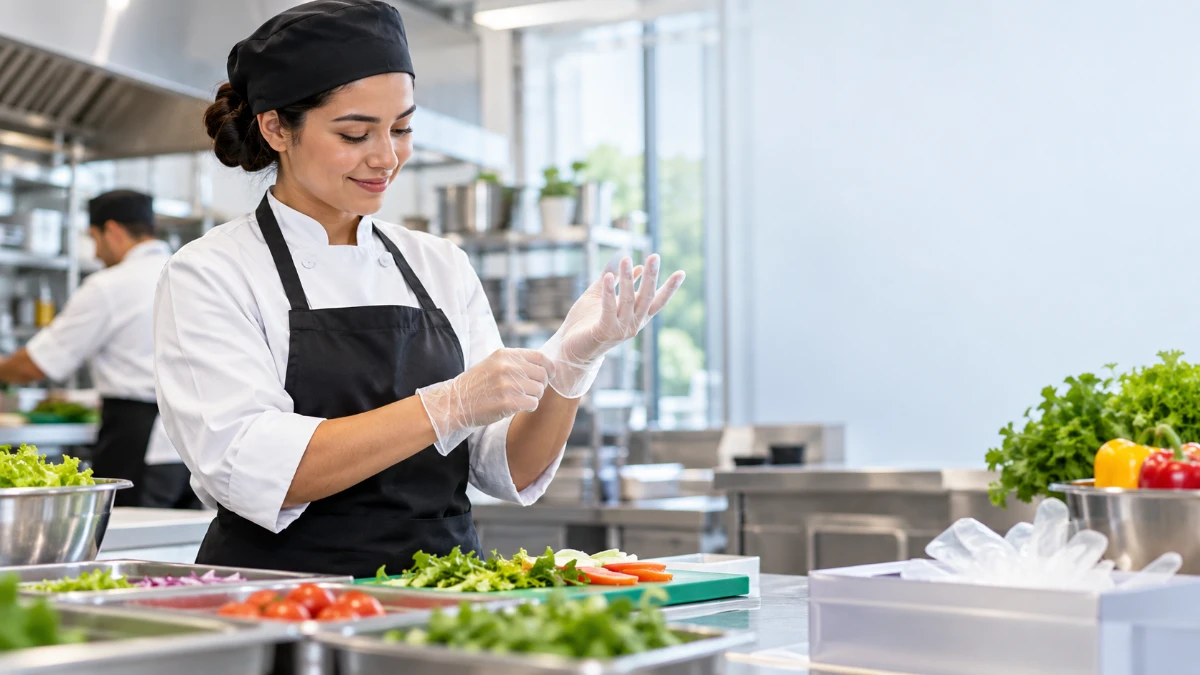
ServSafe food handler glove questions test one thing: whether you can spot the exact moment a glove stops being clean. Gloves cover bare-hand contact with ready-to-eat food, but they only work when hands are washed first, and they have to come off the instant a task changes, raw meat gets touched, or a phone, trash can, or register gets handled. A glove is only as safe as the last thing it touched.
A worker who has just broken down a delivery of raw chicken, wiped a hand on an apron, and moved straight to plating a sandwich is still wearing the same pair of gloves the whole time. Nothing about them looks dirty. That gap between how gloves look and what they are actually carrying is why glove questions show up so often on the food handler exam, and why they trip up people who know the rule but miss the moment it applies.
What Do ServSafe Food Handler Glove Questions Really Test?
The ServSafe Food Handler assessment is 40 questions with no time limit. All 40 are scored — there are no pilot items the way there are on the Manager exam. You need 30 correct out of 40, which is 75%, to earn the Certificate of Achievement. It is non-proctored, and you get three attempts before you have to buy the course again.
Our full-length Food Handler practice tests follow that shape: 40 questions, no clock, every question scored, and a practice pass at 30. The five content areas are weighted evenly at eight questions each. Because some jurisdictions run their own rules, you choose California, Texas, Utah or the General edition at purchase and eight of the forty come from that jurisdiction’s own requirements.
Glove questions rarely test the rule by itself. A question that just asked “should gloves be worn when handling ready-to-eat food?” would be too easy to miss. Instead the exam describes a worker moving through a real sequence of tasks and asks what they should do next, which means the question is really about contamination, not about gloves. Three things decide the right answer every time: whether the food is ready-to-eat, what the worker’s gloved hand touched most recently, and whether a task change happened in between.
When Do Gloves Have to Come Off?
Every glove-change trigger on the exam maps to something a hand could pick up and pass along. The list looks long until you notice it is really one rule repeated: anything that could put a new contaminant on the glove ends that glove’s job.
| What happened | Why the gloves are done |
|---|---|
| Handling raw meat, poultry, or seafood | Raw proteins carry pathogens the cooking step hasn’t neutralized yet |
| Touching face, hair, or clothing | Skin and fabric shed bacteria onto the glove surface |
| Coughing, sneezing, or using a tissue | Respiratory droplets transfer on contact |
| Taking out trash or handling dirty equipment | Waste and soiled tools are a direct contamination source |
| Touching a phone, register, or door handle | High-touch surfaces carry whatever the last twenty hands left behind |
| Switching to a new task | Even a “clean-looking” task change breaks the chain of what the glove is certified for |
| Tearing, leaking, or visible soiling | The barrier itself has failed |
Two of these get missed more than the rest. A worker who steps away to answer a question, taps a register screen, and comes back to plating is changing tasks even though nothing about the food changed. And a glove that “still looks clean” after touching a cooler handle is not evidence of anything — cleanliness on the outside of a glove is not something you can see.
Does Wearing Gloves Replace Handwashing?
No, and this is the single most common wrong answer on the exam. Handwashing comes before gloves go on, every time, as its own step. If hands are dirty when the gloves go on, the contamination moves to the outside of the glove the moment it’s adjusted, and everything that glove touches afterward inherits the problem. A box of clean gloves does not certify the hands going into them.
The same logic runs in reverse. Gloves coming off do not end the sequence — hands get washed again afterward, especially if the next task involves food. Skipping either half of that sequence is the failure mode the exam is built to catch.
How Should Gloves Be Chosen for a Task?
| Task | Bare-hand contact allowed? | Reasoning |
|---|---|---|
| Assembling a sandwich with washed lettuce and deli meat | No | Both ingredients are ready-to-eat; no further cooking step will kill contamination |
| Plating baked rolls for immediate service | No | Rolls are ready-to-eat; use gloves, tongs, or deli tissue |
| Cracking raw eggs bound for the grill | Depends on operation policy | The eggs will be cooked, but cross-contamination to other surfaces still matters |
| Portioning raw ground beef for patties | Yes, if immediately followed by cooking | The cook step is the kill step; gloves are still required before touching anything ready-to-eat afterward |
| Washing produce before it is cut for service | Not a ready-to-eat rule yet | The produce becomes ready-to-eat once washed and cut, which is where the bare-hand rule starts applying |
The exam often rewards reaching for a utensil instead. Tongs, a scoop, or deli tissue remove hand contact from the equation entirely and are harder to get wrong under time pressure than tracking every glove change during a rush.
Four Scenarios the Exam Actually Uses
Prep table. A worker slicing tomatoes reaches into a cooler drawer, shuts the lid, and adjusts a hat before continuing to slice. The gloves touched two non-food surfaces and the worker’s own head. New gloves are required before the knife touches another ready-to-eat item.
Dish pit to service line. An employee unloads clean dishes, carries a trash bag to the dumpster, and comes back to stack sanitized utensils in the same gloves. Trash handling is a contamination event on its own; the gloves needed to change before touching anything clean, food-contact or otherwise.
Receiving to prep. A worker signs for a delivery of raw chicken, breaks down the boxes, and heads to the sink to portion cut fruit without changing gloves. Delivery cardboard and raw poultry packaging both carry contamination risk that has nothing to do with what the worker intends to do next.
Sandwich station opener. A new shift starts, and a worker pulls gloves from a fresh box without washing hands first, reasoning that the gloves themselves are clean. The gloves are clean. The hands going into them may not be, and the exam expects handwashing before gloving regardless of how the shift started.
Common Wrong Answers on Glove Questions
A handful of distractors show up across most glove scenarios, and they share a pattern: each one treats the glove as the thing being protected instead of the food.
- “Keep the gloves on if they still look clean.” Visible cleanliness says nothing about what a glove picked up from a phone, a handle, or a coworker’s shoulder.
- “Rinse the gloves and keep working.” Single-use gloves are not designed to be washed. Rinsing can degrade the material and does not reliably remove what contaminated them.
- “Sanitize hands instead of washing them before gloving.” Hand sanitizer is not a substitute for handwashing under food code rules. It is sometimes used in addition to washing, never in place of it.
- “Double up on gloves for extra protection.” If the outer glove still gets contaminated and never gets changed, the second layer changes nothing.
Twenty Questions About Glove Use
Do food handlers need to wear gloves for every task?
No. Gloves matter most when a worker will have bare-hand contact with ready-to-eat food, such as plating a sandwich or garnishing a plate. Many other tasks, including some raw-food prep and cleaning work, use utensils instead, or involve gloves for reasons unrelated to the ready-to-eat rule, such as chemical handling or worker protection.
When should hands be washed relative to putting on gloves?
Always before, as its own separate step. Gloves go directly over hands, so dirt or pathogens present at that moment transfer to the outside of the glove within seconds of putting it on, and then to whatever the glove touches next. A fresh glove pulled onto unwashed hands does not meet the standard, no matter how clean the glove itself was in the box.
What triggers a glove change during a shift?
Handling raw meat or poultry, touching the face or clothing, taking out trash, touching a phone or register, switching tasks, or any tear or visible soiling. Each of these introduces a contamination source the exam expects you to recognize immediately.
Can single-use gloves be washed and reused?
No. Single-use gloves are manufactured for one task or one short use period, not for repeated cleaning cycles. Washing can weaken the material, create small tears you won’t see, and spread whatever contaminated the glove in the first place rather than removing it. A soiled or suspect glove gets thrown away and replaced, every time.
What counts as ready-to-eat food?
Food that will be served without any further cooking step to kill contamination. Washed lettuce, sliced deli meat, baked rolls, cut fruit prepared for service, and garnishes all qualify, along with anything assembled from those ingredients, like a finished sandwich. Once food reaches this state, bare-hand contact is off the table, and gloves or utensils take over.
What should happen after gloved hands touch raw chicken?
Remove the gloves, wash hands, and put on a new pair before touching anything ready-to-eat or any clean equipment. The raw-protein contact ends that pair of gloves’ usefulness immediately, regardless of how the gloves look, and skipping the handwash step in between leaves the underlying problem unsolved.
Does wearing gloves remove the need to wash hands?
No. Gloves are a barrier laid over hands that are assumed clean already; they don’t clean anything themselves, and they can tear or slip during a task without a worker noticing. Hands still get washed before gloving, and again after gloves come off, especially before the next food-contact task begins.
Can the same pair of gloves last an entire shift at one station?
Only if nothing at that station introduces contamination, which is rare over a full shift. A single sandwich station can involve a cooler handle, a phone, a trash can, and several ingredient changes in a single hour, and any one of those events ends that pair of gloves and starts the clock on a fresh one.
Does touching a cooler handle while gloved matter?
Yes. Handles, touchscreens, and other frequently touched surfaces carry whatever the last several hands left there, whether or not it’s visible. A glove that touches one of these is no longer appropriate for handling ready-to-eat food, and the exam expects that connection to be made immediately, not questioned.
Does wearing two pairs of gloves at once make food safer?
Not meaningfully. If the outer glove becomes contaminated and stays on through a task change, the extra layer underneath does nothing to protect the food it eventually touches. Timing the change correctly matters far more than adding layers, and the exam treats double-gloving as a distraction from the real rule rather than a fix.
Are gloves required for tasks that never touch ready-to-eat food?
Not under the ready-to-eat rule specifically, though other reasons can still call for them. Some cleaning tasks or raw-prep steps call for gloves to protect the worker from chemical exposure or from raw ingredients, and those situations follow different guidance than the food-contact glove rules covered here.
How should gloves be removed without contaminating the hands underneath?
By peeling them off from the wrist inside out, so the outer, contaminated surface folds in on itself and never touches bare skin, then washing hands immediately afterward. Pulling gloves off carelessly, by the fingertips or in a hurry, can transfer whatever the glove picked up directly onto clean hands underneath.
What is the correct order: gloves first or handwashing first?
Handwashing always comes first, as a complete step on its own. Gloves go on hands that are already clean; they aren’t a shortcut around washing hands that weren’t. Reversing that order, gloving up first and treating the gloves as the safety step, is one of the most common exam distractors, and it’s wrong every time it appears.
Can a worker reuse gloves worn while handling trash?
No. Taking out trash is treated as a contamination event on its own, the same as handling raw meat or touching a dirty surface. The gloves need to come off, hands need to be washed, and a new pair goes on before any food-contact task, or even a clean-equipment task like stacking sanitized dishes, resumes.
Why do most glove questions involve a task change rather than a single action?
Because contamination in real kitchens tends to happen between tasks rather than during one. A worker moving from receiving to prep, or from cleaning to plating, crosses a point where the exam expects a glove change even if nothing looks different.
Are tongs or scoops ever the better choice over gloves?
Often, yes. Tongs, a scoop, or deli tissue remove hand contact from the equation entirely and are less likely to be misused under time pressure than tracking every glove change during a fast shift. Either approach satisfies the no-bare-hand-contact rule, and an operation may prefer one over the other depending on the task.
What should be done if gloves tear or become visibly soiled mid-task?
Stop the task, remove the damaged gloves, wash hands, and replace them with a fresh pair before continuing any food-contact work. A torn or visibly soiled glove no longer functions as a barrier, and it should never be taped over, wiped off, or ignored until a break comes.
Do gloves need to be changed after handling money?
Many operations require it, since cash and cards pass through more hands and surfaces than almost anything else in a shift. Where an operation’s own written policy calls for a glove change after handling payment, that policy is treated as the rule for exam purposes, on top of the standard ready-to-eat triggers.
Why can a glove that looks clean still be unsafe?
Because contamination is invisible to the eye. A glove that touched a phone, a door handle, or a coworker’s apron looks identical to one that touched nothing at all, and no amount of inspecting it under a light will reveal the difference. The exam rewards knowing the glove’s history over its appearance.
What is the safest sequence when a worker moves from raw prep to a ready-to-eat task?
Remove the gloves used for raw prep, wash hands thoroughly, and put on a new pair before touching the ready-to-eat item. Skipping the handwash step and going straight from old gloves to new gloves is a common wrong answer, because it treats the glove change as the fix when the hands underneath were never addressed.
Why Glove Rules Exist Beyond the Exam
The food handler credential is built for the people who touch food every shift: prep cooks, line servers, deli staff, bakery workers, and new hires still learning the pace of a working kitchen. None of them manage the operation, but every one of their glove decisions affects whether a guest gets sick.
For a new employee, the glove rule is often the first food-safety habit that has to become automatic rather than something they think through consciously. For an employer, a consistent glove standard across a crew removes one more variable during a lunch rush, when the temptation to skip a change is highest. Health inspectors watch for exactly the failures this article covers: bare-hand contact with ready-to-eat food, gloves that never get changed between tasks, and handwashing skipped before gloving.
Related reading on how the exam handles adjacent hygiene rules: ServSafe Food Handler Questions About Handwashing Explained covers the handwashing side of this same barrier in more depth, and ServSafe Food Handler Questions About Allergens Explained covers the contamination risk that gloves alone can’t solve once an allergen is involved. If exam scenarios in general are giving you trouble, ServSafe Food Handler Exam Mistakes First-Time Test Takers Make walks through the pattern of reasoning behind most missed questions, not just this one.
Practice the scenario logic directly with a free Personal Hygiene practice set, which covers glove use alongside handwashing and illness reporting in the same domain the real exam tests it in. For the complete picture across all five content areas, the ServSafe Food Handler practice test hub is the starting point.
How to Work Through a Glove Question on Test Day
Slow down enough to answer four questions in order: Is the food ready-to-eat? What did the gloved hand touch most recently? Did a task change happen? Does the answer choice fix all of that, or only part of it? The wrong answers on this topic are rarely wrong because they ignore gloves entirely. They’re wrong because they solve only half the sequence, changing gloves without washing hands, or washing hands but reaching for the same contaminated pair.
Once that four-question habit is automatic, the harder version of these questions, the ones that combine a task change with a hygiene lapse, stop feeling like a trick and start feeling like the same rule applied twice.
When you’re ready to see how these show up in a full attempt, the Food Handler full-length practice test runs the same 40-question, untimed format as the real exam, with a written explanation on every question so a missed glove scenario turns into something you won’t miss twice.
Reviewed 23 September 2026 against ServSafe Food Handler exam facts in EXAM-FACTS.md (Zone A) and FDA Food Code guidance on glove use and bare-hand contact with ready-to-eat food.