
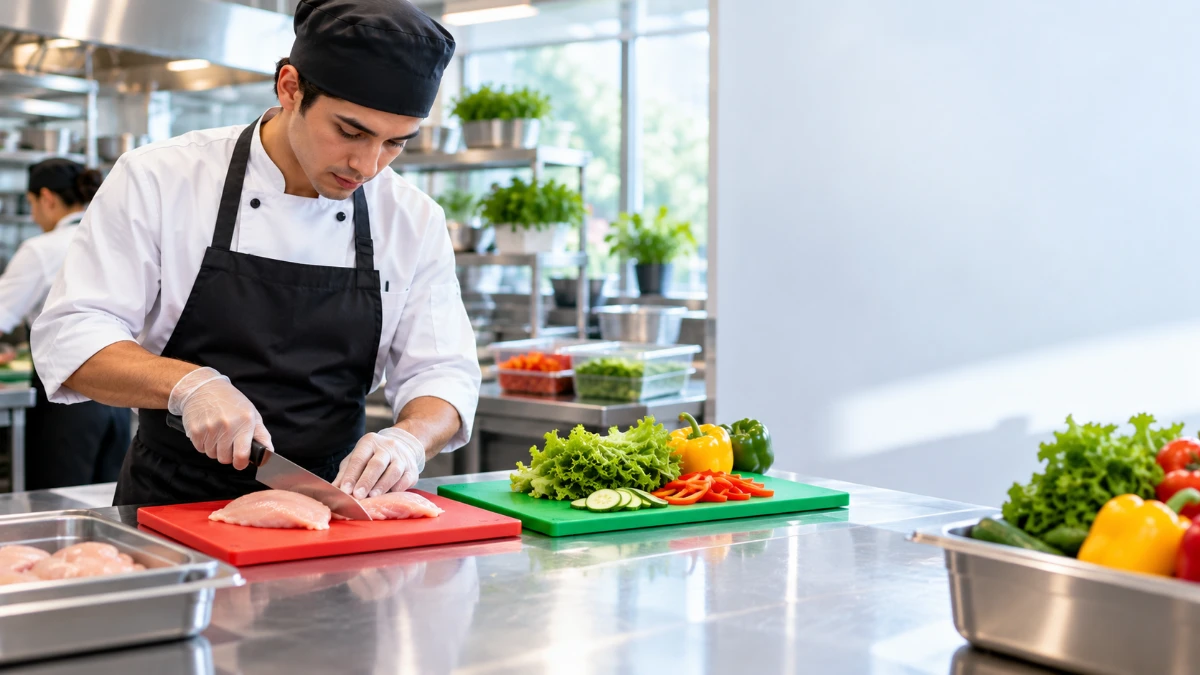
Cross-contact, an allergen moving from one food, hand, surface or utensil onto a food that shouldn’t have it, is tested directly in 8 of the 40 questions on the ServSafe Food Handler exam’s Cross-Contamination and Allergens content area. A peanut-butter knife touching a nut-free sandwich is cross-contact; raw chicken juice on lettuce is a different hazard. Preventing it comes down to handwashing, a full glove change and dedicated or sanitized equipment, since cooking never removes an allergen.
Practice this content area directly on the Cross-Contamination & Allergens practice test before it shows up on the real exam.
What’s the difference between cross-contact and cross-contamination?
The ServSafe Food Handler assessment is 40 questions with no time limit. All 40 are scored — there are no pilot items the way there are on the Manager exam. You need 30 correct out of 40, which is 75%, to earn the Certificate of Achievement. It is non-proctored, and you get three attempts before you have to buy the course again.
Our full-length Food Handler practice tests follow that shape: 40 questions, no clock, every question scored, and a practice pass at 30. The five content areas are weighted evenly at eight questions each. Because some jurisdictions run their own rules, you choose California, Texas, Utah or the General edition at purchase and eight of the forty come from that jurisdiction’s own requirements.
| Term | Hazard | Example | Typical fix |
|---|---|---|---|
| Cross-contact | Allergen (milk, egg, peanut, tree nut, wheat, soy, fish, shellfish, sesame) | A knife cuts a peanut butter sandwich, then a nut-free one without being washed | Handwashing, a full glove change, dedicated or sanitized equipment |
| Cross-contamination | Bacteria, viruses or other pathogens | Raw chicken juice drips onto ready-to-eat lettuce | Proper storage order, cooking to temperature, cleaning and sanitizing |
Both hazards move the same way, through hands, tools and surfaces, which is why exam questions about them can look alike until you check what actually transferred. A bacteria question points to time, temperature or storage order. An allergen question points to a specific ingredient and a specific piece of equipment.
Why does the Food Handler exam test cross-contact?
Entry-level staff touch more food than anyone else in the building. They prep ingredients, assemble orders, change gloves, carry utensils, wipe counters, stock the line and wash dishes, and each of those tasks is a chance to move an allergen somewhere it doesn’t belong. A manager can write the allergen procedure, but the person following it during a Tuesday lunch rush is the food handler.
The exam leans on scenario questions for this reason. A worker handles one food, then another, and you decide whether the steps in between were enough. The questions rarely name a rule directly. They describe an action, wiped, rinsed, switched gloves, cooked longer, and ask whether it stopped the allergen from moving.
How does handwashing prevent cross-contact?
Hands carry allergens fast. Touch cheese, shrimp, peanut sauce or anything with egg in it, then touch another food or a food-contact surface, and the allergen has moved. The ServSafe standard is washing hands before starting a task that could affect allergen safety. A quick rinse or a wipe on an apron shows up in exam questions as the wrong action every time.
Hand sanitizer and gloves don’t substitute for this step. A worker who pulls off dirty gloves and puts on a clean pair without washing first can still transfer whatever was on their hands to the new gloves.
Do gloves stop cross-contact by themselves?
Gloves help when a worker changes them at the right moments and washes hands first. They fail when a worker keeps the same pair on while moving from an allergen task to an allergen-free one. A pair of gloves that just touched croutons with wheat in them carries that wheat to whatever they touch next, gluten-free order or not.
- Change gloves every time the task changes, whether or not they’ve torn.
- Wash hands before putting on a new pair.
- Keep a separate pair, or a separate color, for allergen-free orders where the operation’s policy calls for it.
Which tools and equipment spread cross-contact the most?
Knives, cutting boards, pans, scoops, blender jars, tongs, spatulas and thermometers move between foods dozens of times in a shift, and each pass is a chance to carry an allergen along. The exam’s usual answer is clean and sanitized equipment, or equipment reserved for that one task. A cloth wipe removes crumbs. It does not remove the almond flour dust or shrimp juice underneath them, and whatever food lands on that surface next picks up what the wipe left behind.
How do prep surfaces and storage cause cross-contact?
A prep table holds a dozen ingredients across a shift, opened, portioned, mixed and plated in the same square feet. Cross-contact happens when an allergen-containing food and an allergen-free one share that space without cleaning in between. Storage carries the same risk before prep even starts: a leaking container placed above another food can drip an allergen onto it overnight, and an unlabeled tub of sauce means a worker has no way to know it contains soy or sesame until it’s too late to matter.
What service-line habits cause cross-contact?
Speed is the enemy here. A shared spoon between two pans, a garnish container touched by gloves that already handled shellfish, food set back into the wrong pan, all of it moves fast enough that nobody notices until a guest reacts. The exam tests whether workers use a separate utensil per item, check ingredients before answering a guest’s allergy question, and loop in a manager rather than guess.
Does cooking remove an allergen?
Heat kills most bacteria. It does nothing to an allergen protein. Reheating a dish after it touched peanut oil doesn’t make it safe for a guest with a peanut allergy, and any exam question that implies otherwise is testing whether you know that. Food handlers manage both hazards in the same shift, which is why a question can shift from a temperature detail to an allergen one in the same scenario without warning.
Where does the Food Handler credential get used on the job?
Line cooks, prep staff, dishroom workers, counter staff, deli and cafeteria workers most often hold this credential rather than a manager-level one. It gives an operation a shared baseline: everyone trained on the same handwashing, glove, cleaning and allergen rules, whether they started last week or three years ago. The certificate itself lasts three years, and most operations layer their own site-specific rules on top, like where allergen labels are kept or which cutting board color is reserved for allergen-free prep.
What do cross-contact exam scenarios look like?
Most questions follow the same shape: a worker does something between two tasks, and you decide whether it was enough.
| Scenario | What went wrong | Correct action |
|---|---|---|
| Cutting board used for walnuts, then wiped and reused for strawberries | Allergen residue survives a wipe | Wash, rinse, sanitize and air-dry before reuse |
| Grill and spatula used for shrimp, then chicken for a shellfish-allergic guest | Cooking surface and utensil carry the allergen | Clean surface, clean utensil, follow the operation’s allergy procedure |
| Utensils returned to service with visible residue during a rush | Incomplete wash cycle | Full wash, rinse, sanitize, air-dry before reuse |
| Damaged sauce container leaking onto other boxes during receiving | Spill can reach packaging, storage areas and hands | Isolate the item, clean the area, follow the operation’s rejection policy |
Quick checklist for preventing cross-contact:
- Wash hands before starting a new task.
- Change gloves every time the task changes, whether or not they’ve torn.
- Use separate or freshly sanitized utensils and equipment.
- Clean and sanitize prep surfaces between tasks instead of wiping them.
- Store food to prevent spills, leaks and direct contact.
- Keep ingredient labels clear and legible.
- Check ingredients before answering a guest’s allergy question, rather than guessing.
- Loop in a manager when the operation’s procedure calls for it.
How should you read a cross-contact exam question?
Ask three things: is the hazard an allergen or a pathogen, what physically moved from one place to another, and did the described action fully solve the problem or only partly solve it. Words like wiped, rinsed quickly, picked off and cooked again are usually the exam’s way of flagging an incomplete answer.
For a wider review across the whole credential, the ServSafe Food Handler practice test hub covers all five content areas, and the Food Handler full-length practice test runs the same 40-question, untimed format as the real exam.
Three related posts worth reading: ServSafe Food Handler Questions About Allergens Explained goes deeper on ingredient labeling and guest communication, ServSafe Food Handler Questions About Handwashing Explained covers the handwashing sequence in full, and ServSafe Food Handler Questions About Glove Use Explained works through glove-change scenarios in detail.
FAQs
What is cross-contact in a food service kitchen?
Cross-contact happens when an allergen moves from one food, hand, surface or utensil onto a food that doesn’t contain it on purpose. It’s a transfer problem rather than a cooking problem, and it can happen with a shared knife, an unwashed glove or a leaking container. Even trace amounts matter, since an allergic reaction doesn’t require a full serving to trigger.
What makes cross-contact different from cross-contamination?
Cross-contact involves allergens; cross-contamination usually involves bacteria, viruses or other pathogens. The prevention steps overlap, since both depend on clean hands, clean tools and clean surfaces, but the fix differs by hazard. A bacteria problem calls for temperature control or proper storage order. An allergen problem calls for dedicated equipment, ingredient checks and a full glove change.
Does hand sanitizer stop cross-contact the way handwashing does?
No. Hand sanitizer reduces germs but does nothing to an allergen protein already on a worker’s hands. Handwashing with soap and water is the step that actually removes it. Gloves put on after sanitizer, without a proper wash first, still carry whatever allergen was there before.
Do gloves prevent cross-contact on their own?
No. Gloves work only when a worker washes hands before putting them on and changes them every time the task changes. A pair of gloves that just handled a peanut sauce carries that allergen to the next food it touches, whether the worker meant to switch tasks or not.
When should a food handler change gloves to avoid cross-contact?
Change gloves whenever the task changes, whether or not they’ve ripped or visibly gotten dirty. Moving from raw allergen-containing prep to a nut-free or gluten-free order calls for a full change: remove the old pair, wash hands, then put on a new pair before touching the next food.
Does cooking or reheating remove an allergen from food?
No. Heat can kill many types of bacteria, but it has no effect on an allergen protein. A dish that touched shellfish and then got reheated is still unsafe for a guest with a shellfish allergy. Any exam answer suggesting otherwise should be treated as the wrong choice.
Is wiping a cutting board enough to clear allergen residue?
No. Wiping moves crumbs and dust around rather than removing them, and allergen particles small enough to matter can stay on the surface after a quick pass with a towel. The board and any tool used on it need a full wash, rinse, sanitize and air-dry cycle, or a separate clean board needs to be used instead.
What should a food handler check before making a special allergy order?
Check the ingredients in every component of the dish, including sauces, garnishes and anything premade, before starting. Confirm the equipment being used hasn’t just touched the allergen in question. If there’s any doubt about an ingredient, ask a manager or check the label instead of guessing.
Can a shared serving spoon cause cross-contact on a service line?
Yes. A spoon moved between two pans carries whatever was in the first one into the second, and speed during service makes this one of the most common ways cross-contact happens on the line. Each item needs its own utensil, and that utensil stays with that pan for the shift.
How should allergen-containing food be stored in a walk-in cooler?
Store it so a leak or spill can’t reach another food, which usually means below or away from allergen-free items rather than above them. Label the container clearly enough that a worker who didn’t prep it still knows what’s inside. A damaged or unlabeled container gets isolated and flagged rather than left in place.
What should a worker do first when a guest mentions a food allergy?
Take the statement seriously and follow the operation’s allergy procedure rather than answering from memory. That usually means checking ingredient information, confirming with the kitchen, and looping in a manager if there’s any uncertainty. Guessing at an allergy question is the single fastest way to cause a reaction.
Why does a damaged delivery box matter for cross-contact?
A leaking or crushed container during receiving can spread an allergen to the packaging, the shelf, or the hands of whoever unpacks it, long before any food reaches a plate. Damaged items typically get rejected or isolated per the operation’s policy, and the area they touched needs cleaning before other food goes near it.
What’s the difference between wiping a surface and sanitizing it?
Wiping removes visible debris. Sanitizing means a proper wash, rinse and sanitizer step, which removes the microorganisms and residue a wipe leaves behind. For allergen safety specifically, a surface that’s only been wiped can still carry enough residue to matter to a severely allergic guest.
Which ServSafe Food Handler content area covers cross-contact?
Cross-Contamination and Allergens, one of the exam’s five content areas. Each of the five carries 8 of the 40 scored questions, so this topic is worth exactly as much as personal hygiene, cleaning and sanitizing, time and temperature, or basic food safety.
Can cross-contact happen without any food touching another food directly?
Yes. Hands, gloves, utensils, cutting boards, serving spoons and even packaging can all carry an allergen between foods that never touch each other. A knife that only touched a peanut-containing sauce can pass that allergen to the next food it cuts, with no direct food-to-food contact anywhere in the chain.
What should happen to a leaking allergen container found during receiving?
Isolate it immediately, clean up anything it touched, and follow the operation’s policy on rejecting damaged deliveries. Any packaging or shelf space the leak reached needs cleaning before other food goes back into that spot. Waiting until the shift slows down lets the allergen spread further.
Should raw ingredients with allergens sit above or below other food in storage?
Below, or at minimum sealed and separated so a leak can’t drip onto anything underneath. Storage order for cross-contact runs on the same logic as storage order for bacteria: whatever is more likely to leak or contaminate goes where it can’t reach food below it.
Does an unlabeled sauce container create a cross-contact risk?
Yes. A worker can’t avoid an allergen they don’t know is there, and an unlabeled tub of sauce containing soy, sesame or milk removes that worker’s ability to make a safe decision. Clear labeling is one of the cheapest, easiest controls available, which is exactly why exam questions test whether you’ll flag a missing one.
What’s a common wrong-answer pattern on cross-contact exam questions?
An answer that sounds partly responsible but skips a step: changing gloves without washing hands first, wiping a board instead of sanitizing it, or cooking food longer after it touched an allergen. These read as reasonable on a quick glance, which is exactly why they’re the wrong choice.
Why do dish room habits matter for cross-contact prevention?
Utensils and equipment cycle back into service dozens of times a shift, and a rushed wash during a busy period can leave visible residue, allergen included, on a tool that’s about to touch the next order. A full wash, rinse, sanitize and air-dry cycle actually clears it. A fast rinse under hot water does not.
Reviewed September 23, 2026 against ServSafe’s Food Handler exam blueprint and the 6th Edition, 2022 FDA Food Code.