
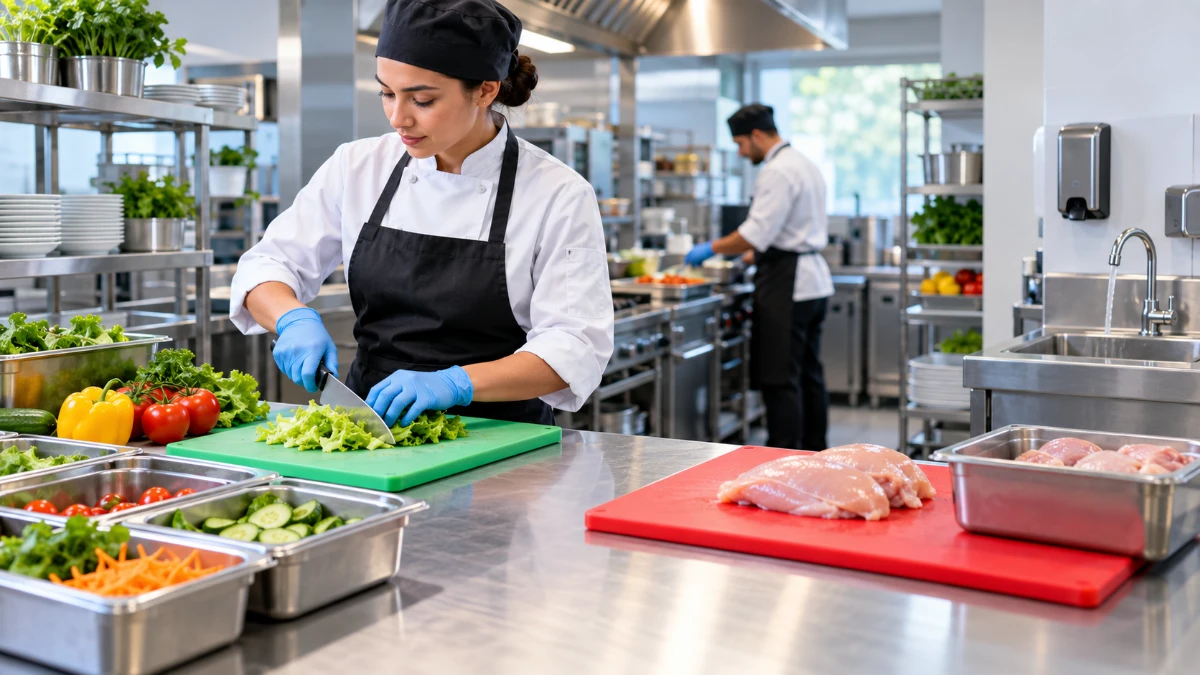
Cross-contamination in a commercial kitchen travels five routes: hands, surfaces, utensils, storage order and prep flow. Block all five by keeping raw and ready-to-eat food apart at every step, washing hands at each task change, cleaning before sanitizing, and storing raw poultry on the bottom shelf below everything else. Run the same sequence every shift and the risk drops sharply.
If you want to see how these ideas are tested before you read on, try the free Cleanliness and Sanitation set for a quick read on your weak spots.
What are the five routes cross-contamination takes?
The ServSafe Manager exam is 90 multiple-choice questions in two hours, but only 80 of them count. The other 10 are unscored pilot items the National Restaurant Association uses for research, and nothing on screen tells you which is which. You pass at 56 of the 80 scored questions — 70%, not the 75% most prep sites publish.
Our full-length ServSafe Manager practice tests copy that structure exactly: 90 questions, 10 unmarked pilot items, a two-hour countdown that submits at zero, and a result worked out of 80 against the same pass line. The seven content areas carry the real exam’s weights rather than an even split — Preparation and Cooking 15, Receipt and Storage 13, Hygiene and Health 12, Cleanliness and Sanitation 12, Facilities and Equipment 12, Management 8, Service and Display 8.
Harmful bacteria, viruses, allergens and chemicals do not need much help to spread. A cook trims raw chicken, wipes a hand on an apron, grabs a pan of washed lettuce, and the lettuce is contaminated before anyone has noticed. Nobody sees the transfer, so prevention has to be routine rather than alertness. Every transfer in a kitchen runs through one of five routes, and each route has its own control.
| Route | How it happens | Control |
|---|---|---|
| Hands | Touching raw food, trash, phones, cloths, hair or face, then touching ready-to-eat food | Wash hands at every task change, before gloves go on |
| Surfaces | A cutting board or table keeps residue in knife grooves or on a wet surface | Scrape, wash, rinse, sanitize and air-dry between raw and ready-to-eat use |
| Utensils and equipment | One knife, tongs or spatula moves between raw and cooked or ready-to-eat food | Separate tools per task, or clean and sanitize between tasks |
| Storage order | Juices drip from a higher shelf onto food stored below it | Shelf order by cooking requirement, ready-to-eat always on top |
| Prep flow | Dirty deliveries and raw prep overlap with the salad or sandwich area | Raw-to-ready flow in one direction, by station or by time |
The first four routes are about what touches the food. The fifth is about where the work happens, and it is the one most kitchens never draw on paper. A kitchen that controls all five gets through inspection without a special push, because the system does the remembering.
When do hands and gloves spread contamination?
Hands are the most common route. Gloves do not change that, because a dirty glove spreads contamination exactly as a dirty hand does. Handwashing comes before glove use, and again whenever the task changes. Hand sanitizer is an addition to handwashing after hands are clean and cannot substitute when hands carry food residue or grease. The wash points below cover most of a cook’s shift.
| Moment | Why it matters |
|---|---|
| After handling raw meat, poultry, seafood or eggs | Raw animal products carry the pathogens that cooking is meant to kill |
| After touching hair, face, body, apron or phone | Each one holds contamination that cooking never sees |
| After taking out trash | Trash is the dirtiest thing in the building |
| After handling dirty dishes or wiping cloths | Soiled items hold food residue and bacteria from earlier tasks |
| After the restroom, eating, drinking, coughing or sneezing | Personal activity moves bacteria from the body to the hands |
| Before switching from raw prep to ready-to-eat prep | Ready-to-eat food gets no later kill step |
The fix for a kitchen where this keeps failing is rarely a lecture. Put a working, stocked handsink within reach of every prep station and keep it free for hands only. When the sink is across the room or full of pots, cooks skip the wash, and the skip happens at the exact moment it matters most.
What is the right storage order in a walk-in?
Shelves follow gravity. Raw juices drip down, so whatever needs the most cooking sits lowest, and food that is eaten as served sits highest. The order follows each food’s minimum internal cooking temperature, so raw poultry lands on the bottom shelf. For more practice on receiving and storage scenarios, work through the receiving and storage questions post, which takes the same shelves from the exam side.
| Shelf | Food | Why it sits there |
|---|---|---|
| Top | Ready-to-eat food, cooked food, washed produce, desserts | Eaten without further cooking, so nothing can drip on it |
| Second | Seafood | Needs less cooking protection than meat or poultry |
| Third | Whole cuts of beef and pork | Cooked to a higher requirement than seafood |
| Fourth | Ground meat and ground fish | Grinding spreads bacteria through the whole piece |
| Bottom | Poultry | Highest cooking requirement, so the highest risk if juices spread |
Unwashed fruits and vegetables need their own place. The ServSafe Manager 9th Edition adds a requirement to separate them from ready-to-eat food, so a case of dirty produce never sits above a tray of cut melon. Covers and lids help but do not change the shelf order, since lids get knocked off and pans get overfilled.
How do you set up prep flow so raw and ready-to-eat never meet?
Draw the path your food takes through the building: receiving door, cooler, raw prep, cooking, ready-to-eat assembly, service. Anywhere two lines cross is a place contamination can cross too. A kitchen with enough space separates raw and ready-to-eat work into different stations. A kitchen without that space separates them by time. Raw work happens first, the station gets a full reset, and ready-to-eat assembly starts on a clean surface.
Receiving belongs in this picture. Boxes come off the truck with raw products beside produce and dairy unless someone sorts them. Keep raw animal products on their own cart, turn away packages that leak, and get cold food into the cooler before it sits in a staging area. For allergen-specific separation, the same logic applies to shared tools and surfaces, and the post on allergen cross-contact covers how that differs from bacterial spread.
What is the correct clean-and-sanitize sequence?
Sanitizer does not work through visible soil, so the order of steps carries the weight. Each step exists because the one before it leaves something behind that would defeat the next.
| Step | Action | What goes wrong if you skip it |
|---|---|---|
| 1 | Scrape or remove food debris | Soil shields bacteria and uses up the sanitizer |
| 2 | Wash with detergent | Grease and residue stay on the surface |
| 3 | Rinse with clean water | Detergent left behind can weaken the sanitizer |
| 4 | Sanitize with an approved solution at the concentration and contact time on the label | Bacteria remain at unsafe levels |
| 5 | Air-dry | A towel puts new bacteria back on the surface |
Quick rinses and wipe-downs do not count as cleaning. A towel is for hands, never for a surface you just sanitized. Keep wiping cloths in sanitizer between uses, give food-contact and non-food-contact surfaces separate cloths, and replace a cloth that has gone greasy. If you are working on the test-question version of this, the cleaning and sanitizing questions post walks through how the exam frames the same steps.
Which raw-to-ready mistakes show up in training and on the exam?
Scenario questions test whether you can trace a contamination path, since a definition alone does not help when a cook is holding tongs. The five below cover most of what turns up in training.
| Scenario | What is wrong | Correct action |
|---|---|---|
| A cook trims raw chicken on a board, wipes it with a cloth and chops lettuce | Wiping leaves the board and likely the knife contaminated | Clean, rinse, sanitize and air-dry the board and knife, wash hands, then use the clean setup for lettuce |
| Tongs place raw patties on the grill and then lift cooked patties to buns | Raw juices on the tongs reach the cooked burger | Use separate tongs, or clean and sanitize the tongs first |
| Raw chicken sits above a covered pan of potato salad | Leaks and drips can happen even when containers look secure | Move raw poultry to the bottom shelf |
| Sanitizer is sprayed on a table covered in food scraps | Sanitizer cannot work through visible soil | Scrape, wash, rinse, sanitize and air-dry before reuse |
| A knife used on a walnut brownie is rinsed and used on plain cheesecake for a guest with a nut allergy | A quick rinse leaves allergen residue behind | Wash, rinse, sanitize, then use a clean utensil and surface for the allergy order |
The pattern in every row is the same. Ask what touched what, in which order, and whether a cleaning step sits between them. The exam is checking whether you can identify the step that removes the hazard first. For more of that reasoning, see how the Manager exam frames cross-contamination scenarios.
Where do busy kitchens break down?
The staff in a kitchen that fails a cross-contamination check care plenty. The system gives out when tickets stack. The weak points are predictable, and so are the fixes.
| Weak point | What happens | Fix |
|---|---|---|
| Shared prep tables | Raw and ready-to-eat work sit too close together | Separate stations or a full reset between tasks |
| Unclear labeling | Staff cannot tell which container or tool was used for what | Label shelves, containers and tools by task |
| Glove habits | Workers change gloves without washing hands first | Handwashing before every new pair |
| Sanitizer checks | Buckets are too weak or too strong | Test the solution on a schedule and log it |
| Delivery storage | Raw items go wherever there is open space | A shelf map posted at the cooler door |
| Service rush shortcuts | The same spoon, tongs or board gets reused without cleaning | Spare tools at every station so nobody has to reuse |
The fix is to remove decision-making where possible. Labeled shelves, color-coded tools, written station procedures and manager spot-checks do more than reminders to be careful.
How should you practice this before the exam?
Cross-contamination scenarios can sit beside hygiene, storage and sanitation items, so practice them inside mixed sets. Start with the ServSafe Manager practice tests to find which scenarios you miss, then drill the topic you get wrong most often. When your domain scores are steady, move to a sitting that matches the real exam’s length and clock. The full-length 90-question Manager test works out your result against 80 scored questions, the same basis as the real pass line.
Kitchen practice carries over too. Pick one prep station and test it against the five routes: tool setup, hand habits, shelf order and cleaning sequence. Fix the biggest risk before the next rush, and do it again the following week.
FAQs
How many routes can cross-contamination take in a commercial kitchen?
This guide sorts the common cases into five routes: hands, surfaces, utensils, storage order and prep flow. Each route has its own control, so a kitchen that trains only handwashing still leaks through the other four. Audit your own line route by route and the gap shows up faster than it does by watching for bad habits in general.
Does color-coding cutting boards prevent cross-contamination?
Color-coding helps because it removes a decision from a rushed cook: green board, produce; red board, raw meat. It only works if the colors are posted, the boards live at the right stations and dirty boards get cleaned and sanitized like any other. A colored board that nobody washes just carries the same bacteria in a different shade.
Whose job is cross-contamination control, the cook’s or the manager’s?
Both, at different levels. Cooks carry out the routine at the station: hand washing, clean tools, correct shelf. Managers design the system that makes the right move the easy one, which means layout, labeled shelves, stocked sinks and spot-checks. When a violation repeats across different cooks, the cause is the system and the fix belongs to the manager.
Can raw chicken and salad share one prep table during the same shift?
Yes, if the table is fully reset between them. Raw chicken goes first, then the table is scraped, washed, rinsed, sanitized and left to air-dry, and the cook washes hands before starting salad. If the rush makes that reset unrealistic, give salad its own station. Shared timing works on slow shifts and fails on busy ones.
How do you store raw food when the walk-in has only two shelves?
Keep the shelf order and change the containers. Ready-to-eat food goes on the upper shelf, raw proteins on the lower, and the raw items sit in lidded, leak-resistant pans so nothing drips down. Where raw poultry and raw beef must share a shelf, poultry still goes lowest in the stack. Add shelving rather than stacking raw over ready-to-eat.
Do you store ready-to-eat food above raw food even when it is covered?
Yes. A lid adds a second layer of defense and cannot replace the shelf order. Covers get knocked loose, pans get overfilled and condensation runs down the outside of containers. Ready-to-eat food goes above raw food whether or not either one is covered, because the storage rule assumes that one day the lid will fail.
Should wiping cloths be shared between stations?
No. Give each station its own cloth, kept in that station’s sanitizer bucket, and keep cloths for food-contact surfaces apart from cloths for floors, handles and other non-food surfaces. One shared cloth moves bacteria from a raw-meat table to a salad table in a single wipe. Replace cloths that are visibly soiled instead of rinsing them and carrying on.
What should a cook do after touching a phone mid-prep?
Wash hands before touching food again. A phone goes everywhere: pockets, restrooms, dining rooms, counters. Treat it like any other contaminated object. The better fix is keeping phones out of the prep zone entirely, in a pocket or a locker, so the question never comes up mid-shift and nobody has to remember the rule.
Does cooking kill the risk from raw juices on a spatula?
Cooking the food does not fix a spatula that carried raw juices to cooked food afterward. Heat kills bacteria on the burger while it is on the grill. A spatula that touched the raw patty and then lifts the finished one puts fresh contamination on a food that will not be cooked again. Use a clean, sanitized tool for the cooked side.
How do you set up a one-way prep flow in a small kitchen?
Sketch the path food takes: delivery door, cooler, raw prep, cooking, ready-to-eat assembly, service. Then remove any crossing. In a tight kitchen you may not have separate rooms, so you separate by time instead. Do raw work first, reset the station completely, then assemble ready-to-eat food. Mark the zones on the wall so new hires can see them.
Can a handsink double as a prep sink?
No. Keep the handsink for handwashing only. Once someone rinses produce, dumps a bucket or fills a pot there, cooks stop using it for hands because it is wet, dirty or blocked, and handwashing drops. Give hands a dedicated sink that is always stocked with soap and paper towels, and use a separate sink for food and equipment.
How should you unload a delivery to avoid cross-contamination?
Stage boxes by category as they come off the truck, with raw animal products on one cart and produce and ready-to-eat items on another. Reject leaking packages, and move cold food to the cooler first, putting each item on its correct shelf as it goes in. Set unboxed items on clean surfaces, never on the dock floor or over another category.
Does unwashed produce have to be stored away from ready-to-eat food?
Yes. The ServSafe Manager 9th Edition adds a requirement to separate unwashed fruits and vegetables from ready-to-eat foods. Soil and surface bacteria on unwashed produce can drip or transfer onto food that will be eaten as served. Give unwashed produce its own shelf or bin, below anything ready to eat, and wash it before it moves into prep.
How do you keep an ice scoop from spreading contamination?
Never leave a scoop inside the ice and never scoop with a cup or glass. Keep a dedicated scoop in a clean, dry holder beside the bin with the handle out of the ice, and wash, rinse and sanitize it on the same schedule as other utensils. Staff should wash hands before touching the scoop handle, since ice is served without further cooking.
What does a manager check in a cross-contamination spot-check?
Walk the line at a busy time and check five things: shelf order in the cooler, tool separation at raw stations, cloths sitting in fresh sanitizer, hands being washed at task changes, and chemicals stored away from food. Write down what you see and fix it on the spot. Spot-checks at the rush reveal more than a tidy walk-through at open.
How do you keep dirty dishes from crossing clean-dish paths?
Make the dish area one-directional. Dirty dishes enter at one end, move through scrape, wash, rinse and sanitize, and leave at the opposite end to air-dry on clean racks. Staff who handle clean dishware should not touch returning trays, and racks of clean items never sit beside soiled ones. Crossing paths is how clean dishes pick up what was just washed off.
Does an apron need changing between raw and ready-to-eat tasks?
Change it when it is visibly soiled or has been splashed with raw juices, and wipe hands on single-use towels instead of the apron. An apron that has been used as a hand towel carries everything you just touched to the next task. Some kitchens assign separate aprons or sleeves for raw prep to make the habit easy to follow.
What should staff do when they spot cross-contamination during service?
Stop, fix the immediate problem and tell the shift lead. Discard food that touched a contaminated surface or tool, replace the tool, and clean and sanitize the station before it is used again. Nobody should quietly serve a plate they suspect. A shift lead who responds calmly teaches staff that reporting a mistake is safer than hiding it.
How do you train new hires so the routine holds on a busy night?
Teach the sequence on a slow shift, then watch it happen on a busy one. New hires learn faster when a station has labeled shelves, posted steps and a named owner for each task. Pair them with a cook who follows the routine consistently, and check them on the same five items you spot-check in everyone else.
Why do kitchens air-dry instead of towel-drying sanitized surfaces?
A cloth or towel puts new bacteria back on a surface you just sanitized. Air-drying gives the sanitizer its contact time and leaves nothing behind to re-contaminate the surface. That is why the sequence ends with air-dry rather than wipe. If the surface has to be used quickly, sanitize earlier in the prep sequence so there is time to dry.
Reviewed 30 September 2026 against ServSafe’s published Manager and Food Handler exam details and the ServSafe Manager 9th Edition update sheet.