
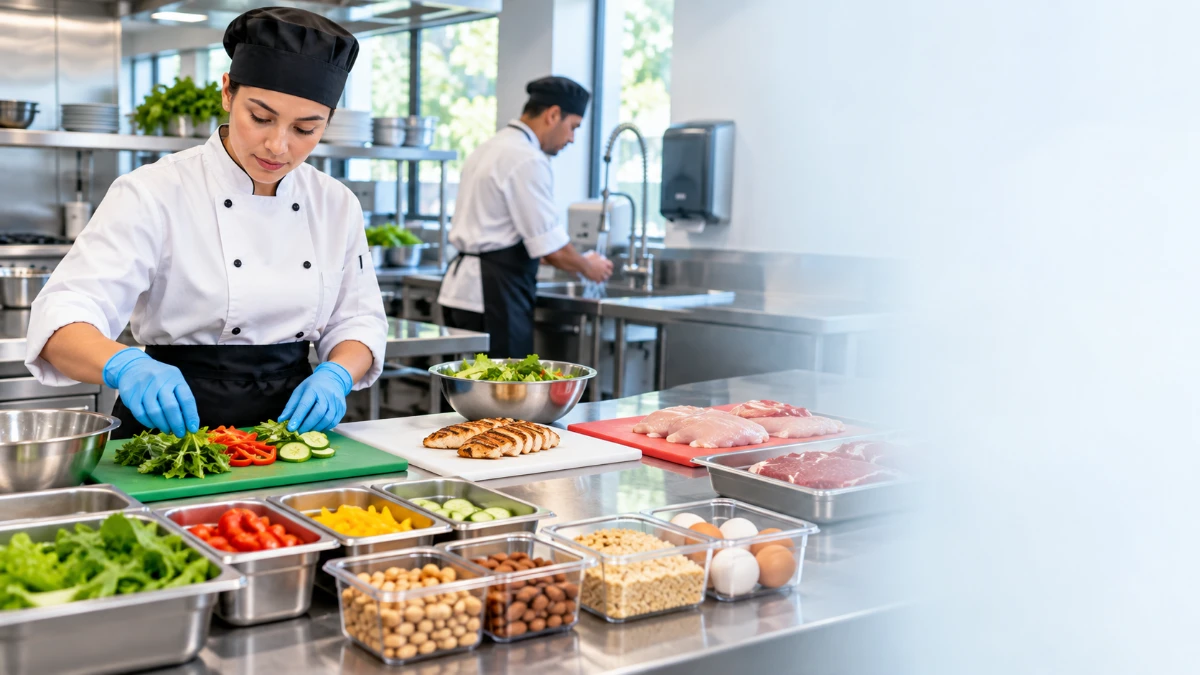
Ten controls prevent allergen cross-contact, running from receiving to the handoff at the table, and cooking is not one of them because heat does not remove an allergen. Each control keeps allergen-free food apart from allergen food at one specific step: ingredients, storage, hands, tools, oil, labels and the plate. The ServSafe Allergens exam gives this topic 12 of its 40 scored questions.
A plate can look right, smell right and be cooked correctly and still put a guest in the hospital. The allergen is invisible, it survives the stove, and it travels on whatever the cook touched last. Most failures in a busy kitchen come from habits nobody notices anymore: the same tongs for two salads, a gloved hand that handled cheese and then built a dairy-free burger, a tub of crushed nuts stored above uncovered prep.
This guide walks the path an allergen takes through a kitchen, from the delivery door to the guest’s table, and puts a control at each stop. If you would rather test yourself on the back-of-house half first, the free back of the house allergen quiz drills exactly that.
What is allergen cross-contact, and how is it different from cross-contamination?
Allergen cross-contact happens when an allergen moves from one food or surface onto a food that is supposed to be free of it. Cross-contamination is the older, broader term for bacteria, chemicals or foreign objects getting into food. The two share a vocabulary (hands, tools, surfaces) and almost nothing else, and mixing them up is how a kitchen ends up with excellent sanitation and a serious allergen problem.
| Hazard | What transfers | Does cooking fix it? | Example |
|---|---|---|---|
| Biological contamination | Bacteria or viruses | Often, if the food reaches the right temperature afterward | Raw chicken juice on a cutting board used for cut fruit |
| Chemical contamination | Cleaner or other chemical | No | Sanitizer splashed onto a prep table |
| Physical contamination | A foreign object | No | A broken piece of plastic in soup |
| Allergen cross-contact | Allergen protein | No | Fries cooked in oil that just fried breaded shrimp, served to a guest with a shellfish allergy |
Wiping a knife with a towel is not enough either. The towel moves the protein around, and the next food picks it up. Prevention has to sit inside the whole system, which is why the rest of this guide is organized by step.
The ServSafe Allergens assessment is 40 questions, all of them scored, with no timer and no pilot items. You pass at 30 of 40, which is 75%.
Our full-length Allergens practice tests lock the same 12 / 10 / 10 / 8 split across the four content areas in every set: Preventing Cross-Contact 12, Understanding Food Allergens 10, Communicating with Guests 10, Responding to an Allergic Reaction 8. Cross-contact carries the largest share because it is where allergen controls are most likely to break down in practice. Coverage runs to 27 topics and includes the Big Nine, sesame included.
Which allergens does a food service team need to know?
The Big Nine, sesame included. Staff do not need food science, but they do need to recognize an allergen inside a real menu item, and the risk is rarely where the guest points. A guest asks about nuts and the problem turns out to be the pesto, the dessert garnish or a scoop shared in the granola.
| Allergen | Obvious sources | Easy-to-miss sources |
|---|---|---|
| Milk | Cheese, butter, cream, yogurt | Whey and casein in processed foods, butter used to toast buns |
| Eggs | Baked goods, mayonnaise | Egg wash, some dressings |
| Fish | Salmon, tuna, cod | Anchovy-based sauces |
| Crustacean shellfish | Shrimp, crab, lobster | Shared fryer oil |
| Tree nuts | Almonds, walnuts, pecans, cashews, pistachios | Pesto, dessert garnish, granola |
| Peanuts | Peanut butter | Sauces, desserts, garnish |
| Wheat | Bread, pasta | Batter, breading, soy sauce in some cases |
| Soy | Tofu, edamame | Soy sauce, some processed foods |
| Sesame | Seeds, tahini | Some breads and sauces, boxed mixes after a recipe change |
What does a kitchen need in place before it starts?
Six things have to exist before any of the steps below will hold. Without them the steps become good intentions.
First, a complete ingredient list for every item, sauce, garnish, seasoning blend and special. Second, a named person who answers allergen questions when a server is unsure. Third, written recipes and prep procedures, because guessing is how mistakes get made. Fourth, labeled storage areas and containers. Fifth, training for servers, cooks, dish staff and managers alike. Sixth, a manager who gives people permission to slow down, ask and remake a dish without being made to feel it cost the shift money.
That sixth item sounds soft and carries more weight than the other five. A cook who is afraid to stop the line will quietly make do with the dirty tongs.
How do you stop allergens at receiving, storage and prep?
Start with the guide below, which compresses all ten controls into one view. The details follow it.
| Step | Control | What it prevents |
|---|---|---|
| 1. Menu | Written allergen reference for every item | Staff guessing what is in a dish |
| 2. Receiving | Read labels, reject unlabeled product | An unknown ingredient entering the building |
| 3. Storage | Sealed, labeled, stored below ready-to-eat food | Spills and crumbs reaching clean food |
| 4. Prep | Clean hands, clean tools, clean surface, in that order | Residue riding from one order to the next |
| 5. Cooking | Know which equipment can be made allergen-safe | Shared oil, water and grill surfaces |
| 6. Guest contact | Repeat it back, check the record, alert the kitchen | Answers given from memory |
| 7. Labels | Specific labels and order flags | Mix-ups at rush and shift change |
| 8. Handoff | A fixed chain from server to table | Casual conversation replacing a process |
| 9. Training | Every role, using your own menu | One person knowing what everyone needs to know |
| 10. Mistakes | Stop, tell the manager, remake | A quiet fix that hides the failure |
Step 1: build the allergen reference
Go item by item and record main ingredients, sauces and marinades, breading and batters, seasoning mixes, cooking oils that are shared, garnishes, dessert toppings and the daily special. Do not rely on anyone’s memory. Recipes change, vendor products change, and a boxed mix that was safe last month may now carry sesame or soy. Update the reference the day a product changes. The format matters less than speed: a binder, a recipe system or a POS note all work if a server can read it mid-service.
Steps 2 and 3: receiving and storage
Allergen control starts at the back door. Check that each item matches the order, read the label for allergen statements and ingredient changes, and reject anything unlabeled whose contents you cannot confirm. Keep product in its original packaging where possible, since the packaging carries the ingredient information. Substitutions are common in food service, and a different bun or sauce from a new supplier quietly makes the menu reference wrong.
In storage the goal is to keep allergen food from dripping, spilling or being confused with something else. Use labeled, sealed containers. Store allergen ingredients below ready-to-eat food where a spill is possible. Keep powders and crumbs such as flour, breading, crushed nuts and sesame topping apart, because they travel. Give each scoop its own bin and leave it there. An open tub of nuts above uncovered produce and one scoop used across several bins are the two storage errors that appear again and again.
Step 4: prep areas and tools
Prep is where most allergen errors happen, because the kitchen is moving and the tools are shared. The order matters: identify the allergy order, gather clean tools, prepare the space, wash hands, and only then start the food. Gloves help only after hands were washed, and a dirty glove spreads an allergen exactly as a dirty hand does. Clean first and sanitize second, because sanitizer works on a clean surface and does nothing useful on top of food residue. If peanut sauce is still on a spoon, sanitizer alone leaves it unsafe.
Where an operation serves allergy orders regularly, dedicated tools for the common allergens make the right habit the easy one. Prep allergen-free meals away from splatter, crumbs and steam from allergen food.
Which cooking methods spread allergens?
Every method that shares a medium. Many staff believe heat makes a dish safe for an allergic guest. It does not, because the allergen is a protein that survives the stove.
| Equipment | How it spreads an allergen | Safer approach |
|---|---|---|
| Shared fryer | Oil carries protein from breaded fish or shrimp into the fries | Dedicated fryer, or do not offer fried items for that order |
| Shared grill surface | A bun toasted in butter leaves milk protein behind | Clean the surface fully, or use a clean pan |
| Pasta water | Gluten-free pasta cooked in water used for wheat pasta defeats the purpose | Fresh water and a clean pot |
| Pizza oven and peels | Flour, cheese and toppings transfer easily | Clean peel, separate pan or screen |
| Steam table and ladles | Utensils moved between pans spread allergens fast | One utensil per pan, kept with its pan |
If your kitchen serves allergy orders often, decide ahead of time which equipment can truly support an allergen-safe order and which cannot. An honest “we cannot guarantee that” is safer than a confident guess.
How should staff talk to a guest who mentions an allergy?
The process starts the moment the guest says it, and it is a safety control as much as a service skill. Train front-of-house staff to listen and take it seriously, repeat the allergen back to confirm it, check the approved ingredient record instead of memory, and alert the kitchen and the manager using the house procedure.
Good sounds like this: “You have a sesame allergy. I’m going to mark that on the order and confirm which items can be prepared safely.” Poor sounds like this: “I think that should be fine.” The word “think” means the system failed. A guest with an allergy needs certainty, or an honest statement that the dish cannot be guaranteed.
How do labels and the handoff keep an allergy order safe?
An allergy order should never live in someone’s head. Use clear labels or POS flags on guest orders with allergies, prepared ingredients that contain allergens, house-made sauces and dressings, and batch-prepped food stored for later. If a container is relabeled by hand, make it specific. “Sauce” is useless; “contains soy and sesame” is a decision someone can act on at 7 p.m. on a Saturday.
Then fix the chain the order travels along. A workable sequence has seven links:
- The server marks the allergen clearly on the order.
- The server tells the manager or designated lead.
- The kitchen lead reviews the order and confirms a safe method.
- The cook washes hands, gathers clean tools and prepares the dish separately.
- The dish is plated and kept apart from other orders.
- A manager or trained lead verifies it before it leaves the kitchen.
- The server delivers it directly to the correct guest.
The chain works because it removes guessing. Each person has one job, and nobody has to remember what the person before them said.
Who needs allergen training, and what happens after a mistake?
Everyone who touches food or answers a guest. Servers need the words to use, cooks need safe prep, dish staff need to know why proper washing matters, and the person expediting needs to protect the final plate from mix-ups. Training lands best when it uses your own menu and your own equipment. If you run a shared fryer, teach that exact risk. If one station uses almonds, show how the dust travels.
Even a strong system will eventually have a bad night. If staff suspect an allergen mistake, nobody fixes it quietly. Stop service of the item, tell the manager, and remake the dish from scratch with clean tools and surfaces. If the food reached the guest, follow your operation’s emergency procedure and call emergency services if the guest shows signs of a serious reaction. Afterward, find the cause: a wrong label, a shared scoop, an order that was never flagged. A short review after each near miss prevents the next one.
How does this show up on the ServSafe Allergens exam?
Cross-contact is the single largest content area on the assessment. The exam is untimed, every one of its 40 questions is scored, and you pass at 30 of 40 (75%).
| Content area | Questions | Share |
|---|---|---|
| Preventing Cross-Contact | 12 | 30% |
| Understanding Food Allergens | 10 | 25% |
| Communicating with Guests | 10 | 25% |
| Responding to an Allergic Reaction | 8 | 20% |
| Total | 40 | 100% |
The steps in this guide map onto three of the four areas. Receiving through cooking is Preventing Cross-Contact, the guest conversation and labeling are Communicating with Guests, and the mistakes section is Responding to an Allergic Reaction. For the exam angle on the same ground, see how cross-contact questions are asked on the Food Handler assessment.
A worked question
A cook finishes a shrimp basket order, then needs to cook fries for a guest who has a shellfish allergy. The fryer is shared. What should the cook do?
- A. Wipe the fry basket, then cook the fries in the same oil
- B. Cook the fries last so the oil has been filtered
- C. Tell the manager the fryer cannot be used for this order and prepare the fries another way
- D. Cook the fries at a higher temperature
Correct answer: C. The oil that cooked the shrimp now carries shellfish protein, and no wipe, filter or temperature change takes it back out. The safe answer is to say the equipment cannot support the order and use clean equipment or offer another item.
Why D is tempting and wrong. Heat feels like the universal fix in food safety, and it is for bacteria. An allergen is a protein, and cooking does not remove it.
To drill the pattern across the whole blueprint, the ServSafe Allergens practice tests are free to start. When you want to see whether it has stuck under exam conditions, the full-length Allergens test runs all 40 questions against the same 30-point pass line.
Frequently asked questions
Does filtering fryer oil remove allergens?
No. Filtering removes crumbs and debris and leaves the allergen protein in the oil. Oil that has cooked breaded shrimp, nuts or battered fish stays an allergen oil until it is replaced. For an allergy order, use a dedicated fryer or fresh oil in clean equipment, or offer a dish that does not need frying.
Should a kitchen use color-coded utensils for allergens?
Yes, where it fits the operation. Color coding makes the right tool obvious at speed, which is when mistakes happen. Assign one color per allergen or one color for allergen-free prep, write the rule down, and keep each tool with its station. A color code only works if staff can explain what each color means.
Does a dish machine remove allergen residue from tongs and cutting boards?
Proper warewashing removes residue when the item goes through clean and complete. The risk sits before that: tools stacked soiled, boards that were never scraped, and a rack pulled out half-washed in a rush. Check items come out visibly clean, and keep tools with ingredients that carry allergens from being returned to the line without a full wash cycle.
What should go on an allergy order ticket?
Name the specific allergen, flag the ticket so it cannot be missed, and record the table or order number. A bare “allergy” note is not enough because the cook cannot tell whether it means sesame or shellfish. If the guest named several allergens, list every one, and make sure the flag follows the order to the pass.
Can I rely on a supplier’s “may contain” label?
Treat it as information that needs a decision from you. A “may contain” statement tells you the product shares a facility or line with an allergen, so an allergy order should not receive it without checking. Record what the label says in your allergen reference and have the manager decide how the item is used.
What if a guest says a little of the allergen is fine?
Prepare the order as a full allergy order anyway. A guest’s casual wording does not tell staff how sensitive they are, and a guest’s tolerance on one day is not a safe assumption on the next. Treat every stated allergy with the same controls, and let the guest decide whether to accept a stated limitation.
Who should carry an allergy meal to the table?
The person who took the order or a trained lead should carry it, and they should deliver it directly to the correct guest. Handing it to a runner who does not know it is an allergy plate breaks the chain. If a runner does carry it, a visible flag on the plate tells them to confirm the guest’s name.
Do allergen-free meals need a separate prep area?
A dedicated area helps, but a clean, cleared and sanitized section of the line works when space is tight. What matters is no airborne flour, no splatter and no steam from allergen food reaching the plate. If neither option is possible, say the kitchen cannot guarantee the order instead of improvising.
Can you pick the allergen off a finished dish?
No. Removing a topping leaves protein behind on the food underneath, so the dish is no longer allergen-free. Walnuts removed from a salad have already touched the lettuce, and cheese lifted off a burger has already left milk protein on the patty. Remake the dish from the start with clean tools.
Can flour dust cause allergen cross-contact?
Yes. Flour and other fine powders hang in the air and settle on nearby food, tools and surfaces. In bakeries and pizza operations, keep allergen-free prep away from dusting and bagging stations, cover finished plates, and wipe down surfaces before starting. Sweeping with dry tools can raise dust again, so damp cleaning suits the area better.
Do wiping cloths and sponges spread allergens?
Yes. A cloth that wiped a nut-crumbed counter carries that protein to the next surface it touches. Use clean, sanitizer-ready cloths for allergen-free prep, and never reuse the same cloth between an allergen station and an allergen-free one. Replace cloths as soon as they are visibly soiled or used on an allergen surface.
Is a shared garnish station safe for allergy orders?
Only if each garnish has its own utensil and its own container and nobody reaches across. A shared station is a common hidden risk because crushed nuts, sesame and cheese sit inches from fresh herbs. For an allergy order, take garnish from a clean, covered supply or leave the garnish off.
What if a supplier changes a product without telling us?
Re-read the label every time a product is received, and treat any change in packaging, brand or code as a trigger to check ingredients. Update the allergen reference the same day. If the new label is missing or unclear, reject the item or hold it out of allergy orders until the contents are confirmed.
How often should an allergen matrix be reviewed?
Update it whenever a recipe, product or supplier changes, and check it against the live menu on a regular schedule your manager owns. The event-based update matters more than the calendar, because most errors enter through an unannounced substitution. Date each review so staff can see how current the reference is.
Should staff taste food to check for allergens?
No. Tasting a dish to check for an allergen exposes the taster and cannot detect protein reliably. Use the ingredient record and the label. If the record cannot answer the question, the honest response to the guest is that the item cannot be confirmed safe, and the dish stays off the table.
Are buffets and self-serve stations a cross-contact risk?
Yes, and a high one. Guests share serving spoons, drip from one tray into another and move utensils between dishes. Give every dish its own utensil, label each dish with its allergens, and keep an eye on the line. Many operations tell allergic guests to order from the kitchen instead.
How do you handle allergy orders for takeout and delivery?
Treat them like dine-in allergy orders, with the same flag, the same prep controls and the same verification, then seal and label the package so the allergen note travels with it. The guest cannot ask a server at the table, so the label has to say what was prepared and what was avoided.
Does a vegan or gluten-free label mean a dish is allergen-free?
No. A vegan dish can contain nuts, soy or sesame, and a gluten-free dish can contain milk or eggs. Each label answers one question about one ingredient. Check the dish against the specific allergen the guest named, and check the preparation as well, because shared equipment can undo the label.
How much of the ServSafe Allergens exam covers cross-contact?
Preventing Cross-Contact is the largest content area, with 12 of the 40 scored questions, or 30% of the exam. The other three areas carry 10, 10 and 8 questions. Because every question is scored and the pass line is 30 of 40, a weak cross-contact score is hard to make up elsewhere.
What happens to an allergy order at shift change?
It transfers by name, out loud and on the ticket, to the incoming lead before the outgoing lead leaves. A flag on the ticket should survive the change, and the incoming lead should re-verify the dish before it goes out. Orders already in progress are the ones most likely to lose their allergy note in the handover.
Where to go next
Related reading: preventing cross-contamination in a commercial kitchen for the bacteria side of the same hands, tools and surfaces problem, and how allergen questions appear on the Food Handler assessment.
The fastest check on whether any of this has stuck is a timed sitting of the full Allergens test linked above. Pick one menu item today, trace it from the receiving door to the table, and write down the first hidden risk you find. That single exercise teaches more than rereading the list.
Reviewed 1 October 2026 against the ServSafe Allergens assessment structure and content areas, as confirmed on 29 August 2026.