
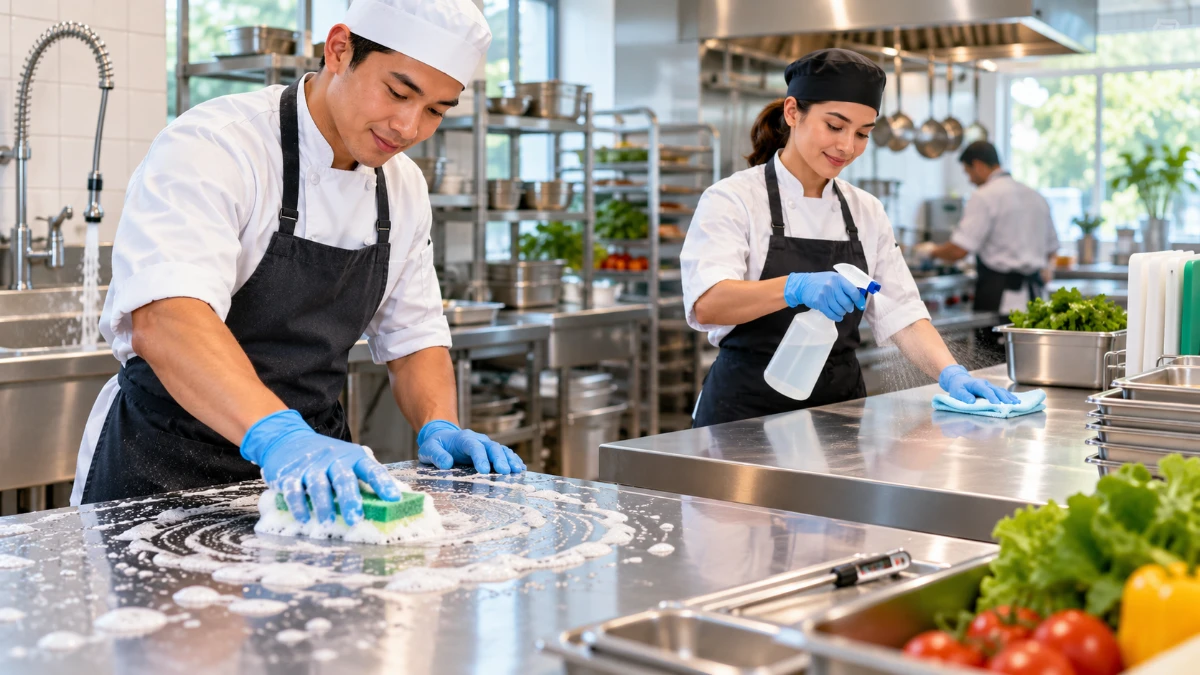
Cleaning and sanitizing are two separate steps, and ServSafe tests them in 8 of the 40 scored Food Handler questions and 12 of the 80 scored Manager questions. Cleaning removes soil, grease and food residue. Sanitizing then reduces germs on that clean surface to a safe level. Sanitizer applied to a dirty surface cannot do its job, so the order is always clean first, sanitize second.
Walk past any prep station at 4 p.m. and it will look clean to most people. That look settles nothing, because the soil you can see is only part of what is on the surface, and a damp cloth can spread the rest around. This post separates the two jobs, puts them in order, and shows where workers mix them up. If you want to test yourself as you read, the free Cleaning and Sanitation practice test covers this one content area on its own.
What is the difference between cleaning and sanitizing?
Cleaning is physical removal. You scrape, wash and rinse until food, grease and dirt are gone. Sanitizing comes after and uses heat or an approved chemical to cut the number of germs on the cleaned surface to a level public health standards treat as safe. One job handles what you can see, and the other handles what you cannot.
| Point of comparison | Cleaning | Sanitizing |
|---|---|---|
| What it does | Removes food, grease, dirt and residue | Reduces germs on a clean surface |
| What does the work | Detergent or soap, water and scrubbing | Heat, or an approved chemical at the label strength |
| What it needs | A rinse to carry loosened soil away | Full contact time on a surface that is already clean |
| What it cannot do | Reduce germs to a safe level | Work through soil or grease |
| Where it applies | Every surface in the operation | Food-contact surfaces, utensils and equipment |
| How you check it | Look and feel: no residue, no film | Test strip for chemicals, or the machine’s heat reading |
The ServSafe Food Handler assessment is 40 questions with no time limit. All 40 are scored — there are no pilot items the way there are on the Manager exam. You need 30 correct out of 40, which is 75%, to earn the Certificate of Achievement. It is non-proctored, and you get three attempts before you have to buy the course again.
Our full-length Food Handler practice tests follow that shape: 40 questions, no clock, every question scored, and a practice pass at 30. The five content areas are weighted evenly at eight questions each. Because some jurisdictions run their own rules, you choose California, Texas, Utah or the General edition at purchase and eight of the forty come from that jurisdiction’s own requirements.
What does cleaning involve?
Cleaning means taking contamination off the surface with your hands and a detergent, and it starts with scraping loose food so it does not smear. A slicer with grease on the blade, a prep table with dried sauce, a pitcher with milk film inside and a board with raw chicken juice all fail for the same reason: something is still on them.
Looks mislead here. A board can pass a glance and still hold residue in its knife grooves. The test is whether the surface is free of film, not whether it looks acceptable from standing height.
What does sanitizing do, and why does it come second?
Sanitizing lowers the germ count on a surface. It does not sterilize, and it was never meant to. The aim is to bring contamination down far enough that food placed on the surface stays safe to eat.
It comes second because soil gets in the way. Grease, starch and dried protein sit between the sanitizer and the surface, and some sanitizers are weakened by the food residue they meet. A sanitizer can only act on what it reaches. Reverse the order and the product is spent on the mess instead of the germs under it.
What is the correct order of steps?
Most food-contact items follow the same five-step sequence, and every step exists because skipping it causes a specific failure.
| Step | Action | What goes wrong if you skip it |
|---|---|---|
| 1 | Scrape or remove loose food | Food smears and clogs the wash water |
| 2 | Wash with detergent and water | Grease and protein stay on the surface |
| 3 | Rinse | Detergent and loosened soil remain and interfere with the sanitizer |
| 4 | Sanitize with heat or an approved chemical | Germs survive on a surface that only looks clean |
| 5 | Air-dry | A towel puts fresh contamination back on the surface |
Air-drying also protects the contact time. A surface that is dried by hand before the sanitizer has finished its work has been rushed through step four.
Where do food workers mix up the two steps?
Most errors begin with loose language. A lead says “sanitize the prep station” and means the whole sequence, and a new worker hears a single spray. The mix-ups below account for most of what goes wrong at the sink and the prep table.
| Mix-up | Why it fails | Fix |
|---|---|---|
| Spraying sanitizer over visible food | The cleaning step was skipped | Scrape, wash and rinse first |
| Wiping tables with one cloth all shift | A soiled cloth spreads contamination | Keep cloths in fresh sanitizer solution and replace them when soiled |
| Treating soap as a sanitizer | Soap removes soil but does not sanitize | Add a sanitizing step after the rinse |
| Treating hot tap water as a sanitizer | Only a heat method built for sanitizing counts | Use the machine or procedure your code approves |
| Spraying and wiping straight away | The sanitizer had no contact time | Leave the surface wet for the label time, then air-dry |
| Trusting the smell of sanitizer | Smell says nothing about strength | Check the solution with the matching test strip |
Picture a prep cook who finishes raw chicken on a board, sprays it and wipes it off in five seconds. The board was never washed and the sanitizer never had time to work. The only version of that task that counts is wash, rinse, sanitize, wait and dry.
What controls how well a sanitizer works?
Kitchens use chemical sanitizers such as chlorine, quaternary ammonium (quats) and iodine, or heat-based methods built into dish machines. The product matters less than five variables, and every one of them is set by the label or the machine, not by guesswork.
| Variable | What it decides | Where the answer lives |
|---|---|---|
| Strength | Too weak fails to reduce germs, too strong leaves residue and is unsafe | Label, checked with a strip made for that chemical |
| Contact time | How long the surface must stay wet | Label |
| Solution temperature | Whether the chemical performs as intended | Label |
| Rinse after use | Whether a final rinse is allowed or required | Label and local code |
| Compatible surfaces | Which materials the product can touch | Label |
A chlorine strip does not read a quat solution, so the strip has to match the sanitizer. A bucket mixed by eye is a bucket nobody has verified. If cloths and food soil have been dragged through it all shift, test it again before you trust it, and remake it when it fails.
Why do workers rush contact time?
Contact time is the stretch a sanitizer must stay on a surface to do its work. It is the step busy workers cut first because it looks like waiting. If the label calls for a set time, wiping the surface sooner gives you a wet table and no sanitizing.
Training should cover the process and not just the word. A new worker needs to know how wet the surface should be, how long it stays wet, whether it air-dries, and whether a final rinse applies to that product.
How do different surfaces change the routine?
| Surface or item | Cleaning focus | Sanitizing focus |
|---|---|---|
| Prep tables | Remove residue between tasks | Sanitize between raw and ready-to-eat work |
| Cutting boards | Scrub knife grooves where moisture and food collect | Sanitize and air-dry before the next food |
| Slicers and mixers | Take apart the parts that touch food | Sanitize the detachable parts after cleaning |
| Utensils and smallwares | Wash and rinse | Sanitize in the sink sequence or the machine |
| Probe thermometers | Wash the stem between foods | Sanitize the stem before the next food |
| Floors, walls, waste bins | Clean on the cleaning schedule | Not held to the food-contact standard |
Wiping the outside of a mixer is a different job from cleaning the bowl and attachments that touch batter. Decide what touches food, then match the procedure to that.
What is the difference between clean, sanitize, disinfect and sterilize?
| Term | Meaning in a food operation | Where it applies |
|---|---|---|
| Clean | Soil and residue removed | Every surface |
| Sanitize | Germs reduced to a safe level on a clean surface | Food-contact surfaces and utensils |
| Disinfect | A stronger germ kill | Restrooms and similar areas, with products labeled for it |
| Sterilize | All microorganisms destroyed | Medical and laboratory settings, not kitchens |
More chemical never improves the result. An over-strength solution can harm workers, damage equipment and leave residue where food is prepared.
Who decides the details: the label, the employer or the code?
The principle is fixed everywhere: clean first, sanitize second. The details are layered. The product label sets strength, contact time and rinse. Your employer’s written procedure sets frequency, tools and who signs off. Your local food code sets what the inspector checks, including approved sanitizers, test methods and dish machine requirements. The three should agree. When they seem to conflict, ask the person in charge before guessing, since the wrong procedure is both a safety problem and a compliance problem.
What should each role focus on?
| Role | Biggest risk | Priority |
|---|---|---|
| Prep cooks | Switching from raw to ready-to-eat without a full cycle | Stop, clean and sanitize between tasks |
| Dish staff | Skipping the rinse or shortening the sanitize step | Hold to the sequence and test the solution |
| Servers and hosts | One cloth carried through the whole dining room | Approved wipe-down method, cloth storage, fresh cloths |
| Shift leads and managers | Test strips missing, no schedule, no training | Provide supplies, schedule checks, verify what staff do |
| New hires | Hearing one word and doing one step | Learn the five-step sequence on day one |
For more of the Food Handler angle, see how Food Handler exam questions frame cleaning and sanitizing. Supervisors preparing for the Manager exam will find the harder scenarios in Manager-level cleaning and sanitizing questions.
A worked question
A prep cook finishes slicing raw chicken on a board, sprays the board with sanitizer, wipes it off at once, and starts cutting lettuce on it. What should the cook have done?
- A. Sprayed a second coat of sanitizer before cutting the lettuce
- B. Wiped the board with a dry towel
- C. Washed, rinsed and sanitized the board, given the sanitizer its full contact time, and let it air-dry before the lettuce
- D. Rinsed the board with hot tap water
Correct answer: C. The board was never washed, so the sanitizer was sprayed over chicken residue, and wiping at once removed it before it could work. The whole cycle has to run before a ready-to-eat food touches the board.
Why A is tempting and wrong. A second coat feels safer, but it lands on the same unwashed surface and is wiped away just as fast. More sanitizer cannot replace the missing cleaning step.
Why D is wrong. Hot tap water rinses off loose soil. It neither cleans the board properly nor sanitizes it, because tap water is not a sanitizing method.
How do the ServSafe exams test this?
| Credential | Content area | Scored questions | Pass mark |
|---|---|---|---|
| Food Handler | Cleaning and Sanitizing, one of five equal areas | 8 of 40 | 30 of 40 (75%) |
| Manager | Cleanliness and Sanitation, 15% of the scored exam | 12 of 80 | 56 of 80 (70%) |
Both exams reward the same habit: read a scenario, find the step that was skipped or done out of order, and pick the answer that restores the sequence. When you want to find out whether the sequence has stuck, a full-length Food Handler practice test gives you all 40 questions under the real shape of the exam. If a kitchen where you work also handles allergens, cross-contamination versus cross-contact shows where cleaning does a job that sanitizing cannot.
Frequently asked questions
What is the difference between a detergent and a sanitizer?
A detergent lifts grease and food soil off a surface so it can be rinsed away, while a sanitizer reduces germs on a surface that is already clean. Detergent does the cleaning step and sanitizer does the sanitizing step. Neither product does the other’s job, which is why a kitchen needs both and why the wash-rinse-sanitize sequence has separate stages.
Is disinfecting the same as sanitizing in a kitchen?
No. Disinfecting is the term for the stronger germ kill used on restrooms and similar surfaces, while sanitizing is the step that applies to food-contact surfaces. A product sold as a disinfectant may not be approved for surfaces that food touches. Use the product your operation has chosen for food-contact sanitizing and follow its label.
What is the difference between sanitizing and sterilizing?
Sterilizing destroys all microorganisms, while sanitizing only reduces them to a level public health standards treat as safe. Kitchens sanitize because the goal is to prevent foodborne illness, and a sterile cutting board adds nothing to that goal. Sterilizing belongs to medical and laboratory settings, so the word does not appear on a food-contact cleaning procedure.
Why can’t you sanitize a greasy or food-covered surface?
Soil sits between the sanitizer and the surface, so the chemical or heat never reaches the germs underneath, and food residue weakens some sanitizers. Grease, starch and dried protein all do this. Wash and rinse the surface first, then sanitize the bare surface. Extra sanitizer does not fix a surface that was never cleaned.
Does an all-purpose spray cleaner count as a sanitizer?
Only if its label says it sanitizes food-contact surfaces and you use it the way the label directs. Many all-purpose sprays are cleaners, and a cleaner covers the cleaning step only. Check the label for a food-contact sanitizing claim before relying on it, and ask your supervisor which product the kitchen has approved.
Can you add sanitizer to the soapy wash water to save a step?
No. Detergent and sanitizer belong in separate steps with a rinse between them. Mixed together, soap and soil can interfere with the sanitizer, and nobody can confirm that the sanitizing step actually happened. Wash in one sink, rinse in the next, and sanitize in a third, or follow the equivalent sequence on your machine.
Can I mix my own sanitizer from household products?
Use the sanitizer your operation has approved and mix it exactly as the label or dispenser directs. Improvising from household products risks a solution that is too weak to work or too strong to be safe on food-contact surfaces. Strength matters in both directions, and only a matching test strip tells you which side of the line the bucket is on.
What does a manager mean by “sanitize the station”?
In practice it means clean, rinse and then sanitize the station. Managers use the shorthand because the first two steps are assumed, and that shortcut is where new workers go wrong. If you are told to sanitize a surface that has visible food on it, clean it first. Treat the instruction as the whole sequence unless told otherwise.
What should I do if I am not sure whether something needs cleaning, sanitizing or both?
Ask the person in charge before guessing, and do both on anything that touches food. Cleaning is always safe to do first, and sanitizing a clean food-contact item costs only a minute. The written procedure for your station and the product label settle most questions, and supervisors would rather answer than correct a mistake afterward.
Does a sanitized surface stay sanitized?
Only until something contaminates it again. A sanitized board that touches raw chicken, a dirty cloth or a bare hand is no longer sanitized, and it needs a full clean-and-sanitize cycle before ready-to-eat food goes on it. Sanitizing protects a surface at the moment it is done, which is why the step repeats between tasks.
Do I need to clean and sanitize at closing even if nothing looks dirty?
Yes. Appearance cannot tell you what residue dried on the surface during the shift, and the next crew should start on food-contact surfaces that are clean and sanitized. Follow the written closing checklist for each station rather than judging by sight, and record it if your operation keeps a cleaning log.
Do floors and walls need sanitizing?
They need regular cleaning, but they are not food-contact surfaces, so the sanitizing standard for prep tables and utensils does not apply to them in the same way. Floor cleaning still matters for pest control and for the shoes and wheels that carry soil around. Your cleaning schedule sets the task, frequency and product for each area.
Do ice scoops and ice machines need both steps?
Yes. The scoop touches ice that people consume, so it is cleaned and sanitized like any food-contact utensil and stored with its handle out of the ice. The machine interior follows the manufacturer’s instructions and your written cleaning schedule, which cover both steps. Never use a glass or cup to scoop ice.
Do probe thermometers need cleaning and sanitizing?
Yes, between uses. A probe that goes from raw chicken into a cooked item moves germs between them, so wash and rinse the stem and sanitize it before each new food. Sanitizing wipes made for food-contact use are a common shortcut. Clean the probe before sanitizing it, since residue on the stem blocks the sanitizer as it would on any surface.
What should you do when tongs or a scoop fall on the floor?
Treat them as contaminated and replace them. Set them aside to be fully washed, rinsed and sanitized before anyone uses them again, and take a clean set. Wiping them off or spraying them in place skips the cleaning step. Dropped utensils pick up soil from the floor, which is exactly the residue sanitizer cannot get through.
When should a sanitizer bucket be remade?
Remake it when a test strip shows it out of range, when it looks dirty or cloudy, and whenever your procedure calls for a fresh batch. Food soil and repeated top-ups weaken a bucket during the shift, so an old solution tells you nothing about its strength. Test before you trust it, and replace instead of topping up.
Who is responsible for checking sanitizer strength during a shift?
Your operation’s written procedure names the person, and in most kitchens it is the shift lead or person in charge, with workers testing whenever they make or refill a bucket. Managers own the system: test strips on hand, a schedule for checks, and training. Every worker who mixes or uses sanitizer shares the job of testing it.
How do you explain cleaning versus sanitizing to a new hire in one sentence?
Cleaning gets the mess off, and sanitizing makes the clean surface safe to put food on, so you always do them in that order. Then show it: scrape a dirty board, wash and rinse it, sanitize it and let it air-dry, saying each step aloud as you go. New hires remember the sequence they watched.
What belongs on a cleaning and sanitizing schedule?
List each item or area, the task, the method, the product, how often it is done, and who signs off. Separate the cleaning task from the sanitizing task wherever both apply. A schedule that only says “sanitize slicer” hides the cleaning step, and that missing step is the one inspectors and exam questions both look for.
Do both ServSafe exams test the cleaning-versus-sanitizing distinction?
Yes. Cleaning and Sanitizing is one of five equal content areas on the Food Handler assessment, worth 8 of the 40 scored questions. On the Manager exam, Cleanliness and Sanitation is worth 12 of the 80 scored questions, 15% of the total. Both ask you to put the steps in order and spot the skipped one.
What is the one rule to remember?
Cleaning removes the mess and sanitizing reduces the germs, and the second step only works after the first. Remove residue, wash, rinse, sanitize at the strength and contact time on the label, and let it air-dry. Then follow your employer’s procedure for the specific surface. Workers who run the full sequence every time protect customers and pass inspections without thinking about it. The Food Handler practice hub collects every free test if you want more drills.
Reviewed 4 October 2026 against the published ServSafe Food Handler and Manager exam parameters. Sanitizer strengths, contact times and temperatures are left to the product label, the equipment instructions and your local food code.