
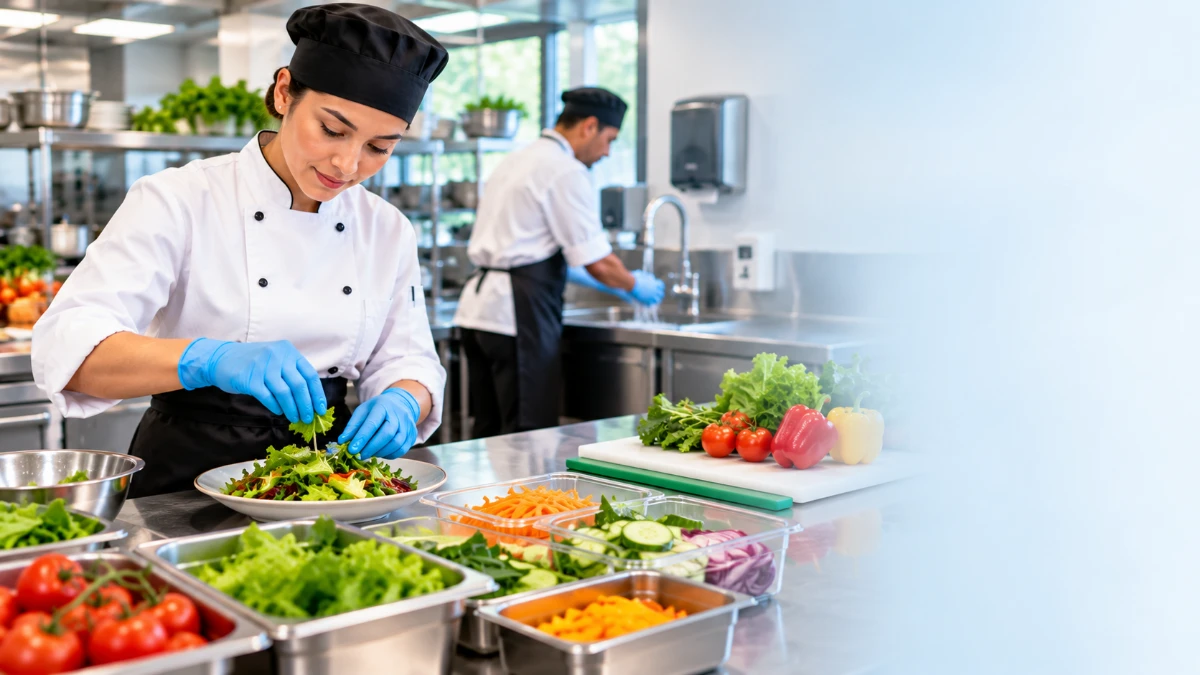
Gloves protect food only while the glove itself is clean, and the ServSafe Manager exam tests that idea inside Hygiene and Health, which carries 12 of the 80 scored questions. Wash hands before putting gloves on, wear them for one task, and replace them whenever the task changes or something dirty is touched. A glove never replaces handwashing.
Drill this area by itself with the Hygiene and Health free practice test before reading on.
How does the ServSafe Manager exam test glove use?
The ServSafe Manager exam is 90 multiple-choice questions in two hours, but only 80 of them count. The other 10 are unscored pilot items the National Restaurant Association uses for research, and nothing on screen tells you which is which. You pass at 56 of the 80 scored questions — 70%, not the 75% most prep sites publish.
Our full-length ServSafe Manager practice tests copy that structure exactly: 90 questions, 10 unmarked pilot items, a two-hour countdown that submits at zero, and a result worked out of 80 against the same pass line. The seven content areas carry the real exam’s weights rather than an even split — Preparation and Cooking 15, Receipt and Storage 13, Hygiene and Health 12, Cleanliness and Sanitation 12, Facilities and Equipment 12, Management 8, Service and Display 8.
Glove questions on the Manager exam are contamination questions in costume. Hygiene and Health is 15% of the blueprint, and glove scenarios draw on it alongside handwashing and bare-hand contact. The question rarely asks whether to wear gloves. It hands you a worker mid-shift and asks what should have happened before the next touch.
When are gloves required, and when is another barrier better?
The rule protects ready-to-eat food, meaning food that gets no further cooking before a guest eats it: sliced tomatoes, deli meat, lettuce, baked goods, cut fruit, garnishes. Bare hands stay off it. Gloves are one way to do that, and tongs, deli tissue, scoops and spatulas are others. Your local health department sets the details in your jurisdiction, so the table shows the working rule and leaves out local variation.
| Task | Food status | Barrier | Why |
|---|---|---|---|
| Assembling a sandwich | Ready to eat | Clean gloves, with tongs for sliced items | Hands shape the food, so a clean glove is the barrier |
| Portioning sliced cheese or deli meat | Ready to eat | Tongs, deli tissue or clean gloves | A utensil avoids repeated glove changes |
| Placing lemon wedges or pickle spears | Ready to eat | Tongs or clean gloves | Small items still count as ready-to-eat food |
| Plating baked goods | Ready to eat | Deli tissue, tongs or clean gloves | Nothing cooks the food afterward |
| Portioning raw chicken | Cooked later | Gloves optional, wash hands afterward | Heat is the next control; the risk is carrying raw residue to other food |
| Scooping ice for drinks | Ready to eat | A clean scoop kept outside the bin | Ice is food, and a scoop removes the hand |
| Ringing up a sale | Not food | No gloves at the register | Money and screens contaminate any glove that touches them |
A hand wound adds one more step. Cover it with a waterproof bandage and put a single-use glove over the top before any food work. The bandage seals the wound and the glove keeps the bandage from ending up in someone’s lunch.
When do gloves have to come off?
Gloves belong to a task, never to a shift. Put a pair on at 11 a.m. and keep it until the lunch rush ends, and you have dirty hands with a plastic coat. The table lists the events that end a pair.
| Event | What happens next |
|---|---|
| The task changes | Remove gloves, wash hands, put on a new pair only if the next task needs one |
| Raw meat, poultry, seafood or eggs touched | Remove, wash, new pair before any ready-to-eat food |
| Face, hair, apron or phone touched | Remove, wash, new pair |
| Trash, cleaning cloths, door handles or cooler handles touched | Remove, wash, new pair |
| Money, receipts or a payment screen touched | Remove and wash before returning to food |
| Glove tears, leaks or gets damaged | Replace immediately and check what was touched since |
| Worker leaves the station and returns | Wash hands, then a new pair |
| The operation’s own wear-time limit is reached | Change according to the written policy |
Why can gloves still spread contamination?
A glove kills nothing. It moves the contact point from skin to plastic, and once that surface touches something contaminated it passes the problem along as fast as a hand would. Three patterns repeat in real kitchens. A sandwich maker slices tomatoes, scratches an eyebrow and goes back to the bread. A deli worker opens the cooler, grabs a marker, adjusts a hat and portions ham. A bakery employee boxes cupcakes, opens the cash drawer and adds a cookie to the same order. In each case the gloves were contaminated mid-task and the worker felt protected the whole time.
Overuse sits behind most of it. Gloves get sweaty, workers keep them on to avoid the interruption of changing, and one contaminated pair can touch dozens of orders before anyone notices. The false confidence is the hazard. The same logic shows up in how cross-contamination travels through a kitchen, where hands are the first of five routes.
What is the correct order for washing, gloving and changing?
Gloves go on clean hands. Pull them over unwashed skin and the inside of the glove is contaminated before the first task starts.
- Wash hands and dry them.
- Put on gloves for the task that needs them.
- Work only that task.
- Remove the gloves when the task changes or something dirty is touched.
- Wash hands again before the next pair.
Step five is where exam questions hide the error. A worker who strips one pair and snaps on another without washing carries whatever was on the outside of the old glove onto the new one. The handwashing rules for food handlers cover the full wash, rinse and dry sequence, and managers follow the same one.
How do you build a glove policy that works at each station?
A manager’s job is the system around the glove. Workers follow a rule they can see, reach and finish in one motion. The table shows a station-level policy you can adapt.
| Station | Default barrier | Change trigger | What the manager checks |
|---|---|---|---|
| Sandwich line | Clean gloves, tongs for sliced items | Any non-food touch or task change | Sink within reach, clean pairs stocked |
| Deli slicer | Deli tissue and clean gloves | Labeling, phone or cooler handle | Labeling done after glove removal or by a second person |
| Bakery case | Tissue and tongs | Register or napkin touch | Food and payment split between two people |
| Salad bar or hot counter | Serving utensils | Any hand-to-plate contact | Utensils dedicated, handles kept out of the food |
| Front counter | Utensils, gloves for rolls and garnishes | Tray, dish or money touch | One person per food role and per payment role |
Splitting food and payment between two people removes the glove change that gets skipped most often. A station card does more than a lecture, and the best wording is short: Ready-to-eat food only. Change gloves after touching anything else. Managers who want to rehearse hygiene decisions at exam speed can work through the personal hygiene scenario questions for Manager candidates, then check the whole blueprint with the ServSafe Manager practice tests.
How should you study glove scenarios for the exam?
Run every glove question through five checks in order. Is the food ready to eat? Did the worker use bare hands or a clean barrier? Did the task switch? Was something contaminated touched? Was there a handwash before the new pair? The wrong answer usually skips one of those steps.
| Scenario | Correct move | Why |
|---|---|---|
| A worker in gloves makes a ham sandwich, rings up the customer, then starts the next sandwich | Remove gloves, wash hands, put on a new pair | The register contaminated the gloves and the next task is ready-to-eat food |
| A bakery worker boxes cookies, removes gloves and immediately puts on a new pair to plate brownies | Wash hands between the two pairs | Removing gloves can contaminate hands, so a change alone is incomplete |
| A deli employee uses tongs for sliced cheese and bare hands for pickle spears | Use gloves or a utensil for the pickles too | Pickle spears are ready-to-eat food, and wet or small items get no exemption |
| A prep cook in gloves cracks raw eggs, then reaches for chopped lettuce | Remove gloves, wash hands, new pair | Raw animal product moving onto ready-to-eat food is the classic transfer |
| A counter server handles bread with one gloved hand and works the register with the bare hand | Acceptable if the roles stay separate | The food hand never touches contaminated surfaces and the bare hand handles payment |
When these patterns come easily, test your stamina on the full-length 90-question Manager practice test, which runs the real 90 and 80 split against a two-hour clock.
Glove use questions managers ask
What glove policy should a kitchen post at each station?
Post one line at each station that names the food, the barrier and the trigger: ready-to-eat food only, gloves or utensils, change when the task changes or anything else is touched. Add where the clean pairs live and where the handwashing sink is. A policy that fits on a station card gets followed, and a binder policy sits on a shelf.
Can bare hands touch ready-to-eat food if they were just washed?
Washing does not make bare-hand contact with ready-to-eat food acceptable on its own. The default is a barrier: gloves, tongs, deli tissue or a similar utensil. Local health departments set any exceptions and the paperwork behind them, so your jurisdiction has the final word. On the exam, pick the answer that keeps bare hands off ready-to-eat food.
Is double gloving a good idea?
Double gloving gives a kitchen little that a clean single pair and a handwash do not already give, and it slows glove changes, which is the habit worth protecting. Workers hesitate to strip two layers mid-rush. If someone needs extra coverage for a cut, a waterproof bandage under one glove is the usual answer.
Which glove material should a kitchen stock?
Stock single-use gloves in a full range of sizes and pick a material that fits your allergy situation. Latex can trigger reactions in workers and guests, so many kitchens choose nitrile or vinyl instead. Fit matters more than material: loose gloves slip and catch on equipment, and tight gloves split at the fingertips.
What should a worker with a bandaged hand wear?
Cover the wound with a waterproof bandage, then put a single-use glove over it before any food work. The bandage seals the wound and the glove holds the bandage in place. A bandage with no glove over it can fall off into food unseen. Check your local code for anything that looks infected or is draining.
Do cooks need gloves when handling raw chicken that will be cooked?
Gloves are optional for food that gets cooked afterward, because heat is the next control. Hands still get washed after raw meat, and any gloves come off before the worker touches anything ready to eat. The failure happens at the next step, when the same hands move on to salad or garnish. Treat raw handling as its own task.
Should a cashier who also handles food wear gloves?
Separate the two jobs if you can. Money, receipts and payment screens contaminate gloves, so the same person bagging pastries needs a clean pair or a utensil for every food touch. In a rush, assign one person to payment and another to food. That removes the glove change most often skipped.
What do health inspectors look for on glove use?
Inspectors watch what workers touch between glove changes. They notice one pair used through payment, trash and food, bare hands on ready-to-eat items, no handwashing before gloves, and a handwashing sink out of reach. They also listen for whether a manager can explain the policy. A station card and a trained crew answer most of it.
Are gloves required when handling ice?
Ice that goes into drinks is ready-to-eat food, so use a clean scoop kept in a container outside the bin. Never use a glass, and keep bare hands out of the ice. Gloves are the fallback when no scoop is available. A scoop buried in the ice puts a handle that hands have touched into the product.
Are color-coded gloves worth using?
Color coding helps a crew see the task at a glance, with one color for raw proteins and another for ready-to-eat food. It cuts mix-ups at stations that run several jobs at once. It does nothing if workers skip the change, so treat it as a visual reminder on top of handwashing and task-based glove changes.
How do you train staff to change gloves without slowing the line?
Build the change into the layout. Put the glove box and the handwashing sink within a step of the line, stage ingredients before the rush, and split food and payment between two people. Then rehearse the full sequence at the real station for a few shifts until it runs on habit instead of memory.
How do you remove gloves safely?
Pinch the outside of the first glove at the wrist and peel it off inside out. Slide a bare finger under the cuff of the second glove and peel it off over the first. Drop both in the trash, then wash your hands before touching anything else or putting on a new pair.
Who decides when gloves are required in my operation?
Your local health department decides. ServSafe states that requirements can vary by jurisdiction and that the local health department is the authority. Your employer can add stricter rules on top, but cannot set a lower standard than the local code. When in doubt, ask the department that inspects you.
Are tongs or deli tissue acceptable instead of gloves?
Yes. Tongs, deli tissue, scoops, spatulas and dispensing equipment all count as barriers for ready-to-eat food. They often work better than gloves for repeated portioning because no glove change is needed. Gloves fit tasks where hands have to shape or arrange the food, such as assembling a sandwich.
Do glove questions appear on the ServSafe Manager exam?
Yes, as scenarios rather than definitions. Hygiene and Health carries 12 of the 80 scored questions, and glove, handwashing and bare-hand situations draw on that area, with cross-contamination themes elsewhere. You pass at 56 of 80, which is 70%. Read each scenario for the missing step: a handwash, a change or a barrier.
What should a worker do when a glove tears during service?
Stop, remove the glove and wash hands before putting on a new pair. Tell the manager what the torn glove touched, because food handled since the tear may need to be set aside. Check the product for any piece of glove that might have come off. Replace damaged gloves the moment you notice them.
How often should gloves be changed during a rush?
Change gloves on events, not on a timer: a new task, a dirty touch, raw food, a tear or a break. A rush multiplies those events, so more changes happen, and busy is never a reason to skip one. Your operation’s written policy may add a maximum wear time on top of the triggers.
Where should glove boxes be stored in a kitchen?
Keep glove boxes where workers can reach them without leaving the station, away from splash and raw food. A wall-mounted dispenser beside the handwashing sink works well. A box left on a prep surface collects drips, and a box across the kitchen tempts workers to stretch one pair through extra tasks.
Does a glove change have to happen between customer orders at a deli counter?
A change is required between orders whenever the gloves touched something other than the food. An order carrying an allergen request calls for a fresh pair and clean tools, because allergens travel on gloves just as bacteria do. For a plain order handled with clean gloves and no side trips, no change is required.
Do gloves protect the worker or the food?
Single-use gloves protect the food from the worker’s hands. They can also keep a worker’s skin away from irritants, but the food-safety job is the barrier. That is why the rule is tied to ready-to-eat food and to contamination events instead of to a worker’s comfort or the clock.
Last reviewed 1 October 2026. Exam figures checked against ServSafe.com’s published Manager exam structure. Glove requirements depend on your local health department, which is the authority in your jurisdiction.