
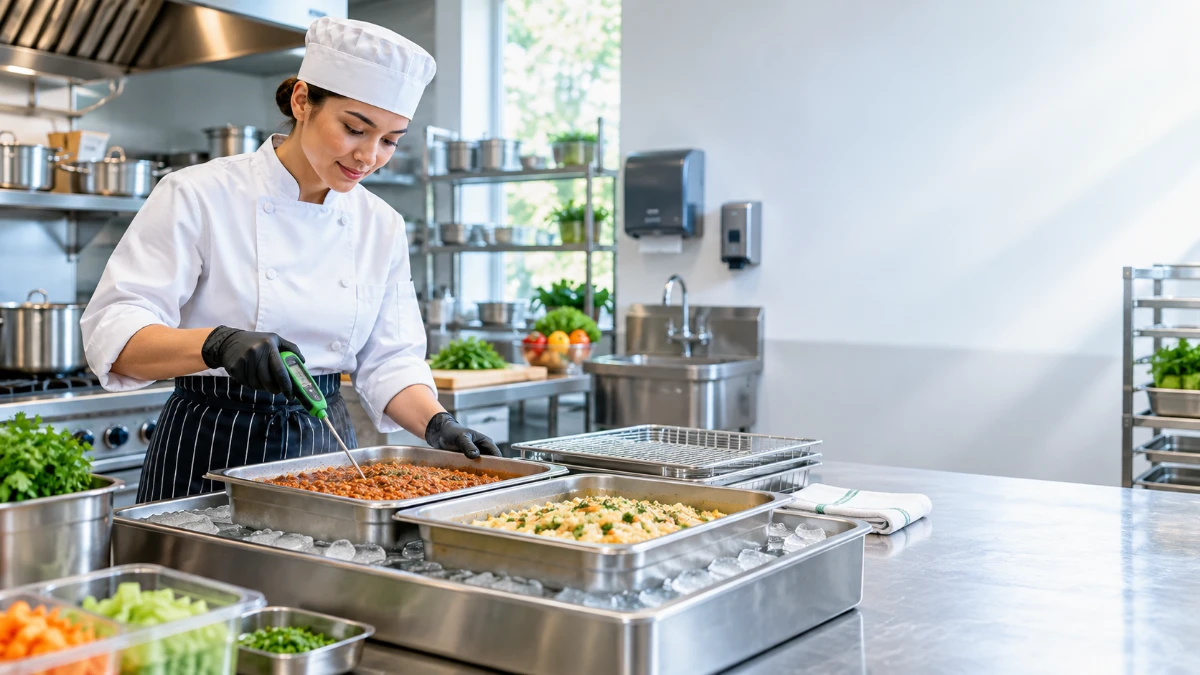
Hot food must cool from 135°F to 70°F within 2 hours, then from 70°F to 41°F or lower within a further 4 hours, for a maximum of 6 hours in total under the FDA Food Code. The first two hours carry the most risk, because bacteria grow fastest in the upper part of the danger zone. Shallow pans, ice baths, stirring and smaller batches get food through it; a deep pot in the walk-in rarely does.
If you want to check the rule against scenarios before reading the detail, the free Safe Preparation and Cooking of Food quiz covers it in isolation.
What are the two cooling stages, and how long do you have?
Cooling is a race with a fixed clock. The clock runs in two legs, and the second leg is only available if the first one was won.
The ServSafe Manager exam is 90 multiple-choice questions in two hours, but only 80 of them count. The other 10 are unscored pilot items the National Restaurant Association uses for research, and nothing on screen tells you which is which. You pass at 56 of the 80 scored questions — 70%, not the 75% most prep sites publish.
Our full-length ServSafe Manager practice tests copy that structure exactly: 90 questions, 10 unmarked pilot items, a two-hour countdown that submits at zero, and a result worked out of 80 against the same pass line. The seven content areas carry the real exam’s weights rather than an even split — Preparation and Cooking 15, Receipt and Storage 13, Hygiene and Health 12, Cleanliness and Sanitation 12, Facilities and Equipment 12, Management 8, Service and Display 8.
| Stage | Temperature range | Time allowed | If the deadline is missed |
|---|---|---|---|
| Stage 1 | 135°F down to 70°F | 2 hours | Reheat to 165°F for 15 seconds and restart cooling with a faster method, or discard |
| Stage 2 | 70°F down to 41°F or lower | A further 4 hours | Follow your health department’s written direction; discard if nobody can prove the times |
| Total | 135°F down to 41°F or lower | 6 hours maximum | The six-hour total governs |
Your local health department is the authority on which edition of the Food Code applies and how it words the rule. The figures above are the ones the ServSafe Manager course teaches.
Why does the first stage matter more than the second?
Bacteria multiply fastest in the warm end of the danger zone. Food that is still above 70°F after two hours has spent those hours in the range where growth is quickest, and some of those bacteria leave toxins behind that cooking later will not remove. That is why stage one carries the tight deadline and stage two gets twice as long for a smaller temperature drop.
The two stages also share time. If food reaches 70°F early, the unused minutes roll into stage two, because the six-hour total is what counts. Here is a batch that comes off the heat at 2:00 p.m.:
| Checkpoint | Deadline | Note |
|---|---|---|
| Reach 70°F | 4:00 p.m. | Stage one limit |
| Reach 41°F or lower, if 70°F was reached at 4:00 p.m. | 8:00 p.m. | The full four hours of stage two |
| Reach 41°F or lower, if 70°F was reached at 3:00 p.m. | 8:00 p.m. | Five hours available, because the six-hour total runs from 2:00 p.m. |
Refrigerators hold cold food cold. They were not built to pull heat out of a hot batch, so a stockpot pushed into the walk-in can hold its centre above 70°F well past the first deadline while warming the food stored around it.
How do you cool a batch step by step?
A fixed routine removes guesswork, and every minute counts once the food leaves the heat.
- Gather equipment before the food comes off the heat. Shallow pans, a sanitized thermometer, ice, labels and a timer should be on the bench first, so nothing waits while the food sits hot.
- Divide the batch. Split a large pot into smaller portions. Thin layers lose heat quickly; a deep five-gallon pot insulates its own centre.
- Write the start time on the label. Stage one is judged against this time, so record it the moment the food drops below 135°F.
- Pick a method that fits the food. Liquids go in an ice bath and get stirred; solids go in shallow pans or on sheet trays, cut smaller where the product allows.
- Stir, rotate and re-ice. Move hot centre food to the cool edges, and replace the ice before the bath turns lukewarm.
- Probe the centre well before the two-hour mark. A check at one hour and another shortly before two hours leaves time to fix a slow batch.
- Move to refrigeration once the pans are shallow and spaced. Leave room for air to circulate, and vent the food loosely until it is cold.
- Confirm 41°F or lower, then cover, label and store. Date mark if your rules require it, and record the result if the kitchen keeps a log.
Which cooling method fits which food?
No single method works for every product. Most kitchens combine two or three, and the choice depends on texture, volume and container.
| Method | Best for | Why it works | Watch for |
|---|---|---|---|
| Shallow pans | Beans, sauces, cooked grains, pasta | Less depth means heat travels a shorter distance to escape | A layer of about two inches is a working rule of thumb in many kitchens; the thermometer has the final say |
| Ice bath with stirring | Soups, gravies, cheese sauce, curry | Water carries heat away faster than air, and stirring brings the centre to the edge | Ice that has melted; water that spills into the food |
| Ice paddle | Stocks, soups, large kettles | A frozen, sanitized paddle chills and stirs at once | Paddles that were not cleaned and sanitized before use |
| Blast chiller | High-volume production, banquets, commissaries | Colder, faster-moving air strips heat from the product | Overloaded trays and deep pans still slow it down |
| Smaller portions | Roasts, whole poultry, dense casseroles | Less mass holds less heat | Portioning after the stage-one clock is already well advanced |
| Ice as an ingredient | Soups, stocks, sauces written for it | Melting ice absorbs heat as it goes into the batch | Recipes that were not designed for the extra water |
A blast chiller is useful but optional. The rule sets targets for time and temperature, and a kitchen can meet them with nothing more than pans, ice and a spoon.
What goes wrong most often?
Cooling failures repeat, and they tend to come from the same handful of habits. A manager who knows them can design them out of the routine.
| Mistake | What it does | Fix |
|---|---|---|
| Leaving food in the cooking pot | Heavy metal holds heat for hours | Transfer to shallow containers straight away |
| Loading a crowded walk-in | Raises the cooler’s temperature and blocks airflow | Space pans out; cool in batches if needed |
| Covering tightly too soon | Traps steam and slows the drop to 70°F | Vent or cover loosely until the food is cold |
| Skipping the two-hour check | Removes the chance to correct in time | Set a timer when the start time is written |
| Using a deep container | Capacity is not the same as cooling design | Choose the pan for depth, not volume |
| Assigning nobody | Each person assumes another did the check | Name one owner per shift |
What should managers check every shift?
The manager builds the system that makes safe cooling routine, and the daily checks are short. Confirm that the ice machine works and that enough shallow pans are clean and available. Read the cooling log from the previous shift for misses and corrective actions, and confirm that a thermometer was calibrated this week. A probe reading 5°F high can turn a failed batch into a passing one on paper.
Treat a failed batch as a process problem before treating it as a staffing one. If the same soup misses stage one every Friday, the batch is probably too large, the pans are too few, or the walk-in is overloaded after prep. Fix the cause, then retrain. For how the hot end of the same clock works, see how the danger zone clock works, and for what comes after cooling, read the reheating rules.
What does a cooling question look like on the exam?
Cooling sits inside time and temperature control. On the ServSafe Manager blueprint, Safe Preparation and Cooking of Food is the heaviest content area at 15 of the 80 scored questions, and Time and Temperature is one of five evenly weighted content areas, 8 of 40, on the Food Handler assessment. The questions reward knowing what to do next, which a scenario shows better than a definition.
A cook pours 4 gallons of soup at 135°F into one deep stockpot at 2:00 p.m. and puts it in the walk-in. At 3:30 p.m. the centre reads 88°F. What should the manager do?
- A. Leave it in the walk-in and check again at 4:00 p.m.
- B. Divide it into shallow pans, set them in an ice bath, stir, and recheck before 4:00 p.m.
- C. Discard the soup now
- D. Reheat it to 165°F for 15 seconds immediately
Correct answer: B. Stage one runs until 4:00 p.m., so 30 minutes remain and the batch can still be saved. The container is the problem, and only a faster method can fix it in the time left.
Why D is tempting and wrong. Reheating is the corrective action for a stage-one miss. Nothing has been missed yet, so the right move is to speed the cooling rather than restart it.
Why A is wrong. It leaves the same deep pot in the same conditions that produced an 88°F centre after 90 minutes, and it gives up the last chance to act before the deadline.
To drill the topic with more of these scenarios, work through the ServSafe Manager practice tests, and keep the TCS food classification guide and the cooking temperature tiers open beside you for the numbers either side of cooling.
Cooling questions, answered
When does the cooling clock start?
The clock starts when food drops below 135°F, which for practical purposes is when it leaves the heat. Write that time on the label straight away, because stage one is judged against it. A container with no start time leaves the crew guessing whether the food is still inside its 2-hour window.
Why does cooling have two stages instead of one six-hour deadline?
Bacteria grow fastest in the upper part of the danger zone, so food has to get through that part quickly. Stage one covers 135°F to 70°F in 2 hours, and stage two covers the slower slide from 70°F to 41°F over 4 hours. A single six-hour deadline would let food sit warm for hours and still pass.
How deep should food be in a cooling pan?
Shallow enough that heat escapes quickly. A layer of about two inches is a working rule of thumb in many kitchens, and it is a kitchen habit rather than an exam figure. Dense foods such as refried beans or mashed potatoes need the thinner end of that range, and a thermometer reading in the centre decides whether the depth worked.
Is it safe to put a lid on food while it cools?
Only loosely. Vent or partly cover food during stage one, because a tight lid traps steam and heat and slows the drop from 135°F to 70°F. Once the food reaches 41°F or lower, cover it fully, label it and store it. Until then, the goal is letting heat out while keeping debris and splash away from the food.
Can I set food on the counter to cool before it goes in the walk-in?
No, because room air removes heat slowly and the stage-one clock keeps running the whole time. Start active cooling straight away with an ice bath or shallow pans. Move the food into the walk-in once it is divided and spaced so cold air can reach every pan, and the pans have already shed most of their heat.
Does an ice bath need water as well as ice?
Yes. Ice alone touches the container at a few points, while ice and water together surround it and carry heat away much faster. Fill the sink or bin with both so the level rises around the food line inside the pot, and add ice as it melts. A lukewarm bath has stopped doing its job.
How often should I stir food in an ice bath?
Stir continuously where the kitchen allows it, and at minimum every few minutes. Stirring moves hot centre food to the cool edges, which is where the heat escapes. One stir every half hour does little for a dense pot. Probe the centre at your set checkpoints and keep stirring between them.
What is an ice paddle and how do I keep it sanitary?
An ice paddle is a hollow, food-safe paddle filled with clean water and frozen, then used to stir hot liquid while chilling it. Wash, rinse and sanitize it before use like any food contact surface, and store it in the freezer between jobs. Never fill it with anything other than clean water.
Can I use the freezer to speed up cooling?
Rarely. Hot pans raise the freezer’s temperature and can partly thaw the frozen food beside them, and a freezer does nothing for a deep pot whose centre stays hot. If you use one, limit it to small shallow portions with space around them, and confirm with a thermometer that stage one was met.
Is a blast chiller required?
No. The two-stage rule requires the time and temperature targets to be met, and pans, ice baths, stirring and smaller batches can meet them. A blast chiller earns its place in high-volume production such as banquets and commissaries. Batch size and pan depth still decide whether it works, so a machine does not rescue a poorly loaded tray.
Why is cooked rice such a cooling problem?
Cooking turns dry rice into a moist food that supports bacterial growth, and Bacillus cereus spores that survive cooking can multiply and form toxin if the rice cools slowly. A full pot stays warm in the middle for hours. Spread rice thinly on sheet trays and push it through both stages without delay.
How do I cool a large roast or whole chicken?
Cut it into smaller portions before cooling, because mass holds heat. A whole roast can stay above 70°F in the centre long after the surface feels cool. Portion it, spread the pieces on shallow trays with space between them, and probe the thickest piece for the stage-one check. Thick pieces take longer than thin ones.
Does adding ice as an ingredient really help?
Yes, when the recipe is built for it. Part of the water goes in as ice after cooking, and the melting ice drops the temperature quickly. It suits soups, stocks and sauces where the extra water is planned. Write it into the recipe ahead of time, because as an emergency fix it changes flavour and thickness.
How do I check the temperature of a dense dish like lasagna while it cools?
Put a calibrated probe into the thickest part at the centre, because that is the last place to cool. Take the reading in the middle of the deepest pan rather than at a corner or edge, and clean and sanitize the probe between items. A surface reading of 70°F can hide a centre well above it.
Does the cooling rule apply to a cold dish like potato salad?
It applies to the cooked ingredients before they are combined. Boiled potatoes or pasta for a cold salad are TCS food that started hot, so they must pass through both cooling stages before mixing with other ingredients. Mixing warm components into a cold salad warms the whole batch and restarts the problem.
Can reheating fix food that cooled too slowly?
Sometimes. A stage-one miss has a defined corrective action: reheat to 165°F for 15 seconds and restart cooling with a faster method, or discard. Reheating does not remove toxins that bacteria have already produced, which is why time spent warm matters as much as the final temperature. Discard when you cannot prove the times.
What should a cooling log record?
At minimum, the food, the start time, the temperature and time at each check, the method used and the initials of the person who checked. Add the corrective action whenever a deadline is missed. A log that only shows passing numbers hides the batches that nearly failed, and those show where the process needs work.
Who should own the cooling check on a shift?
One named person per shift, written on the prep sheet. When the whole crew shares responsibility, the two-hour check gets skipped while everyone assumes somebody else made it. The owner sets a timer at the start, probes at the checkpoint and records the result. The manager reviews the log at close.
Do cooling rules differ by state or county?
The 135°F to 70°F and 70°F to 41°F targets come from the FDA Food Code, but your local health department is the authority and adopts its own edition, which may word the rule differently. Check the version your county has adopted and your company policy before writing procedures. The ServSafe course teaches the Food Code figures.
Does the Food Handler exam cover cooling?
Time and Temperature is one of five content areas on the Food Handler assessment, worth 8 of the 40 scored questions, and cooling belongs to that family of ideas. This site cannot tell you how many of those eight touch cooling, so learn the 135°F, 70°F and 41°F checkpoints and the reasoning behind them.
Where should you go next?
Cooling is the step where a good kitchen gets caught, because it happens after service when the shift is almost over. Learn the two deadlines, practise the scenario pattern, and sit a full run before exam day with the full-length 90-question Manager mock exam, which scores you out of 80 against the same 56-question pass line.
Reviewed 30 September 2026 against the FDA Food Code cooling requirements and the ServSafe Manager exam facts (90 questions, 80 scored, pass at 56 of 80).