
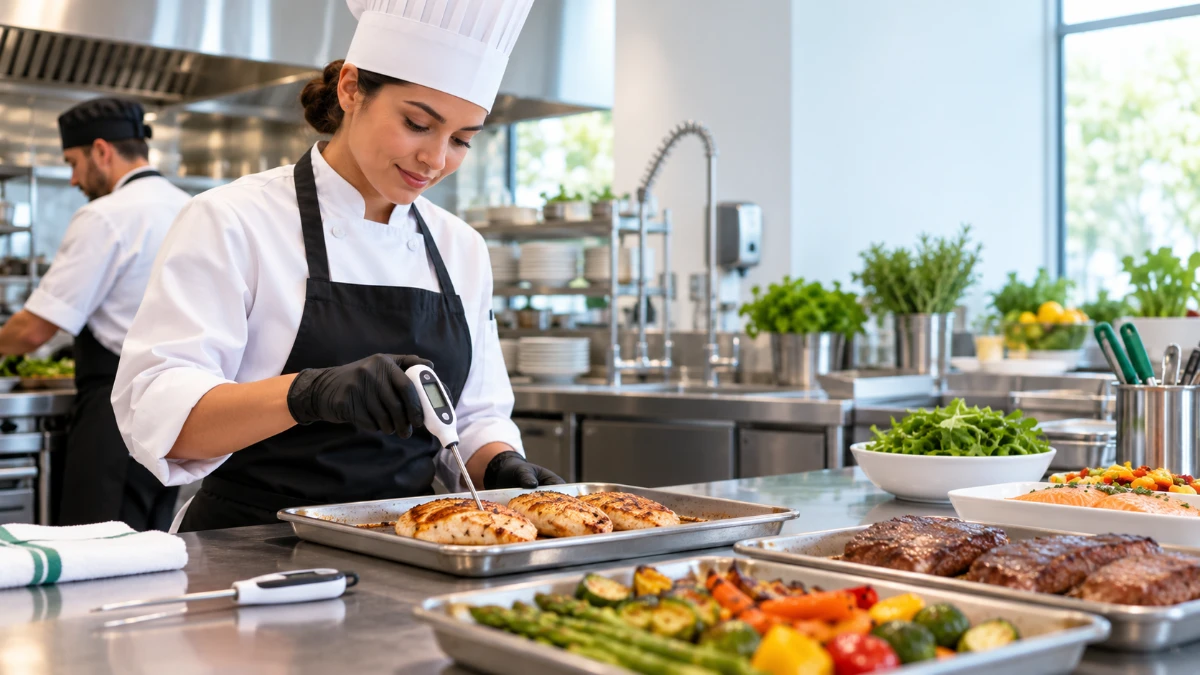
Safe minimum internal cooking temperatures under the FDA Food Code run from 135°F for hot-held plant foods to 165°F for poultry, stuffing, and mixed dishes built from already-cooked TCS ingredients. Ground meat and eggs held for later service need 155°F, whole seafood and steaks need 145°F, and roasts reach that same 145°F but held for four minutes instead of fifteen seconds. Every number pairs a temperature with a hold time.
The Safe Preparation and Cooking of Food practice test drills these exact thresholds in isolation, if you’d rather check what’s already stuck before reading on.
A chicken breast that cleared 165°F and one that stalled at 150°F look identical on a plate — same color, same char marks, same steam coming off the cutting board. How is a cook supposed to know the difference? A thermometer, held in the thickest part for the right number of seconds, is the only real answer, and that’s what the rest of this chart exists to support.
Why these five numbers carry more weight than they look like they should
The ServSafe Manager exam is 90 multiple-choice questions in two hours, but only 80 of them count. The other 10 are unscored pilot items the National Restaurant Association uses for research, and nothing on screen tells you which is which. You pass at 56 of the 80 scored questions — 70%, not the 75% most prep sites publish.
Our full-length ServSafe Manager practice tests copy that structure exactly: 90 questions, 10 unmarked pilot items, a two-hour countdown that submits at zero, and a result worked out of 80 against the same pass line. The seven content areas carry the real exam’s weights rather than an even split — Preparation and Cooking 15, Receipt and Storage 13, Hygiene and Health 12, Cleanliness and Sanitation 12, Facilities and Equipment 12, Management 8, Service and Display 8.
Cooking temperature is graded inside that 15-question Preparation and Cooking share, which makes it one of the highest-return blocks of questions on the exam. A single missed number on this chart can cost more than one question, because the same threshold usually reappears in a scenario question later in the same set.
What are the safe minimum internal cooking temperatures?
Use this table as the reference. Every figure comes from the FDA Food Code, the standard used in commercial kitchens and on the ServSafe exam.
| Temperature | Hold time | Applies to |
|---|---|---|
| 165°F (74°C) | 15 seconds | Poultry (chicken, turkey, duck); stuffing made with fish, meat, or poultry; stuffed meat, seafood, pasta, or poultry; dishes combining previously cooked TCS ingredients; reheated TCS food going into hot holding |
| 155°F (68°C) | 15 seconds | Ground meat (beef, pork, and other meats); injected meat; mechanically tenderized meat; ground seafood; shell eggs held for later service |
| 145°F (63°C) | 15 seconds | Seafood (fish, shellfish, crustaceans); steaks and chops of pork, beef, veal, and lamb; commercially raised game; shell eggs served immediately |
| 145°F (63°C) | 4 minutes | Roasts of pork, beef, veal, and lamb |
| 135°F (57°C) | No hold time | Fruits, vegetables, grains, and legumes held hot for service |
Two holding thresholds sit underneath this chart rather than inside it: hot food is held at 135°F or higher, and cold food is held at 41°F or lower. Cooking gets food to a safe starting point. Holding is what keeps it there.
Why do different foods need different cooking temperatures?
Poultry needs 165°F because it’s the category most likely to carry Salmonella and Campylobacter, and stuffing gets the same number because packing food together slows how fast heat reaches the center. Ground meat needs 155°F because grinding moves any surface bacteria into the middle of the product: a whole steak typically carries contamination only on its surface, but grinding that same cut into burger meat spreads the bacteria all the way through.
Whole cuts and seafood reach safety at 145°F because contamination on them, when it exists, tends to stay on the outside, where a hot pan reaches first. Roasts get that same 145°F but held for four minutes instead of fifteen seconds, because the extra time does the same job at a lower peak. Plant foods held hot only need to clear 135°F for a different reason entirely: the Food Code treats them as a holding problem rather than a raw-meat contamination problem, so the number is about keeping them out of the growth range rather than killing something baked into the food from the start.
What temperature does each type of food need?
Grouped by category, so a specific item is easy to look up mid-shift.
| Category | Target | Examples |
|---|---|---|
| Poultry and stuffed items | 165°F, 15 seconds | Whole chicken, turkey breast, duck, ground turkey or chicken, stuffed pork chops, stuffed fish, casseroles with cooked chicken and rice |
| Ground meat and held eggs | 155°F, 15 seconds | Hamburgers, sausage patties, meatloaf, ground pork, injected roast portions, mechanically tenderized steaks, scrambled eggs on a buffet line |
| Seafood, steaks, chops, and eggs served now | 145°F, 15 seconds | Salmon fillet, shrimp, tuna steak, pork chop, beef steak, poached eggs plated immediately |
| Roasts | 145°F, 4 minutes | Roast beef, roast pork loin, roast veal, leg of lamb |
| Plant foods for hot holding | 135°F | Cooked rice, beans, roasted vegetables, pasta, vegetable soup |
A lower number reflects how quickly that category of food reaches a safe core once it’s cooked correctly.
Is reheating food the same as cooking it?
No. Cooking brings raw food up to a temperature that kills what it started with. Reheating deals with whatever grew back in during storage, and the Food Code treats it as its own control step with its own clock: TCS food going back into hot holding must reach 165°F for 15 seconds within two hours, and commercially processed ready-to-eat food, such as canned soup, only needs 135°F because it was already made safe once. The TCS foods guide covers the full reheating and cooling sequence in one place.
What’s the difference between cooking and holding food hot?
Cooking makes food safe by clearing a pathogen-killing temperature once. Hot holding keeps it safe afterward by staying at 135°F or higher, so bacteria that survive elsewhere in the kitchen don’t get a chance to regrow. A tray of chicken can clear 165°F in the oven and still turn into a problem twenty minutes later if it sits at 110°F on the line. The oven did its job. The holding step didn’t.
How do you use a food thermometer correctly?
A chart is only as good as the reading taken against it, and a bad reading creates false confidence, which is more dangerous than no reading at all.
| Step | What it means in practice |
|---|---|
| Pick the right probe | A bimetallic stemmed thermometer suits thick roasts and large cuts; a thermocouple or thermistor reads faster and fits thin items like patties and fillets |
| Probe the thickest part | Center of a roast, the thickest section of a chicken breast or inner thigh, the middle of a casserole, more than one spot in a large batch of soup |
| Keep the probe off bone, fat, and the pan | Bone conducts heat differently, and the pan itself runs hotter than the food, so either one produces a false high reading |
| Let the reading settle | Pulling the probe out too soon, even with a fast digital unit, can record a number the food hasn’t actually reached |
| Clean and sanitize between uses | A probe that goes from raw chicken to cooked chicken without cleaning moves bacteria onto food that’s already finished |
| Calibrate on a schedule | A thermometer that drifts by even a couple of degrees turns a correct-looking reading into a wrong one; ice-point and boiling-point checks catch the drift |
Why do thermometers give false readings?
| Mistake | Why it happens |
|---|---|
| Testing too close to the surface | The outer layer heats first, so a probe near the surface reads high while the center is still unsafe |
| Testing only one spot | Large or mixed items often have both a hot zone and a cold zone |
| Plating too early | Letting food rest doesn’t finish cooking a product that came off the heat undercooked |
| Using the wrong probe for the food | A thick-stemmed thermometer struggles to get an accurate reading from a thin patty or fillet |
| Skipping calibration | A drifted thermometer reports a number that looks official and isn’t |
| Reading steam instead of food | In a soup or a hotel pan, the air just above the surface can read hotter than the food itself |
A common version of this in a real kitchen: a burger that reads 155°F near the edge and 145°F in the center, or a tray of stuffed chicken that looks fully cooked on top while the thickest part of the stuffing is still under temperature.
How do you handle a dish made from more than one ingredient?
Mixed dishes take on the requirement of whichever ingredient carries the highest risk.
| Dish | Required temperature | Why |
|---|---|---|
| Chicken Alfredo bake | 165°F | Contains poultry |
| Stuffed pork loin | 165°F | Stuffing moves the dish into the poultry tier |
| Beef lasagna made with previously cooked meat | 165°F | Built from already-cooked TCS ingredients |
| Seafood stuffing | 165°F | Stuffing raises the requirement regardless of what’s inside it |
The logic holds even when a dish looks simple. A turkey sandwich made with sliced turkey, cheese, and cut tomato is TCS at every layer, and the highest requirement among its ingredients sets the number for the whole sandwich.
Frequently asked questions
What is the single most important cooking temperature to remember?
If only one number sticks, make it 165°F. It covers poultry, stuffed foods, mixed dishes built from previously cooked TCS ingredients, and TCS food being reheated for hot holding. The rest of the chart still matters, since the number changes by food.
Does every temperature on this chart need to hold for 15 seconds?
Most do, but roasts are the exception: they use 145°F held for 4 minutes instead of 15 seconds. Time matters here because killing pathogens depends on both heat and how long the food is exposed to it, and a longer hold at a lower peak does the same job as a short hold at a higher one.
Why is a steak safe at 145°F while a hamburger needs 155°F?
A whole cut like a steak usually carries contamination only on its surface, and searing reaches that surface first. Grinding spreads whatever bacteria was on the surface all the way through the meat, including the center, which is why ground beef needs a higher number than the steak it came from.
Can hot holding equipment be used to reheat cold food?
Rarely. Hot holding equipment is built to maintain a temperature, and it lacks the power to bring cold food up to a safe one quickly, so food creeping up slowly in a steam well spends far too long in the danger zone. Reheat on the range, in an oven, or in a steamer, then transfer to holding.
What should a cook do if a check comes in below the required temperature?
Keep cooking and check again in a different spot rather than guessing from color or texture. A browned burger or a chicken breast that looks done on the outside can still read under temperature at the center, so only a thermometer reading confirms it’s actually safe.
Why do shell eggs have two different safe temperatures?
Shell eggs served immediately need 145°F for 15 seconds, while shell eggs held for later service, such as on a buffet line, need 155°F for 15 seconds. The difference comes down to how long the food will sit before it’s eaten.
Why does a stuffed chicken breast need 165°F when a plain chicken breast also needs 165°F?
Both land on the same number, but for different reasons. Chicken needs 165°F on its own because of the pathogens it commonly carries. Stuffing raises any food to 165°F because packing ingredients together slows heat, so a naturally lower-risk food can end up needing the poultry number just from being stuffed.
Does the cooking method change the required internal temperature?
No. Grilling, roasting, sous vide, and frying all have to reach the same internal number for the same food; the method changes how long that takes and how evenly heat moves through the item. A sous vide steak still needs to hit 145°F somewhere in its process, even if the water bath runs cooler than that for most of the cook.
Why do roasts use a four-minute hold instead of a fifteen-second one?
Roasts are large enough that a fifteen-second hold at a higher temperature would overcook the outside long before the center caught up. Four minutes at 145°F destroys the same pathogens as a shorter hold at a higher number, using the roast’s own mass to carry the heat through evenly.
What temperature applies to a dish made from more than one type of meat?
The dish takes on the temperature of its highest-risk ingredient rather than an average of everything in it. A casserole built from both chicken and ground beef needs 165°F, the chicken’s number, even though the beef on its own would only need 155°F, because the higher requirement covers the whole pan once the two are combined.
Is wild game cooked to the same temperature as commercially raised game?
This chart covers commercially raised game at 145°F for 15 seconds, the same tier as whole cuts of pork, beef, veal, and lamb. Wild game carries different risks depending on the species and how it was processed, and a food service operation serving it should follow its supplier’s and local health department’s specific guidance rather than treat it as interchangeable with a farmed product.
Why does mechanically tenderized meat need 155°F when a whole cut only needs 145°F?
Tenderizing works by piercing the meat with blades or needles, which can carry surface bacteria into the interior the same way grinding does. Once that’s happened, the cut is treated like ground meat rather than like an intact steak or chop.
How is a food thermometer calibrated without special lab equipment?
The two common methods use materials already in a kitchen. The ice-point method checks that a thermometer reads 32°F in a slurry of ice and water; the boiling-point method checks that it reads 212°F at sea level in boiling water. Either one takes a couple of minutes and belongs on a regular schedule.
What’s the practical difference between a bimetallic stemmed thermometer and a thermocouple?
A bimetallic stemmed thermometer needs to be inserted a couple of inches into the food to get an accurate average reading, which makes it a poor fit for thin items. A thermocouple or thermistor reads from just the tip, responds in seconds, and works better on patties, fillets, and other foods too thin for a stemmed probe to average correctly.
Can the pan or dish being used throw off a temperature reading?
Yes. A metal pan or the bottom of a hotel pan runs hotter than the food sitting in it, so a probe that brushes the container instead of staying inside the food can report a falsely high number. Keeping the tip away from the pan, and away from bone in a piece of meat, is part of taking an accurate reading.
Which number wins if a recipe lists a different temperature than the Food Code?
The Food Code minimum wins in a regulated food service operation. A recipe can call for a higher finish temperature for texture or doneness, but it can never call for a lower one than the Food Code requires for that category of food, and a kitchen following a recipe still has to hit the code minimum regardless of what the recipe says.
Can a restaurant serve a steak cooked below 145°F if a customer asks for it?
Some jurisdictions allow undercooked whole-muscle meat and eggs to be served on request, with a consumer advisory posted or stated to the guest, but this varies by local health code and by which foods are covered. A restaurant operating under this kind of exception should confirm its own jurisdiction’s rule rather than assume it applies.
Does ground turkey need a different temperature than ground beef?
No. Both are ground meat, and both need 155°F for 15 seconds under this chart. Grinding is what determines the temperature tier here, regardless of species, so ground poultry stays at the same 155°F as ground beef.
Why do fish and shellfish only need 145°F?
Fish and shellfish sit in the same tier as whole cuts of meat because their contamination risk, like a steak’s, tends to be on the surface rather than distributed through the flesh. Cooking to 145°F for 15 seconds reaches that surface reliably, which is why the requirement is lower than it is for ground or stuffed foods.
Is 135°F a pathogen-kill temperature or just a holding temperature for plant foods?
For plant foods being held hot for service, 135°F is the cooking and holding threshold in one, because the Food Code doesn’t treat rice, beans, or vegetables as carrying the same raw-animal contamination risk that drives the higher numbers elsewhere on this chart. The purpose is keeping the food above the danger zone.
Where to go next
Related reading in the same series: the food danger zone breakdown and foodborne illness types ServSafe tests.
For a broader run at cooking-temperature and food-safety scenario questions, the ServSafe Manager practice test hub covers all seven content areas, and the full-length ServSafe Manager practice test runs the real 90-question, two-hour format end to end.
Reviewed 30 September 2026 against the FDA Food Code and the ServSafe Manager 9th Edition content blueprint. Temperature and hold-time figures verified against FDA retail food protection guidance and cross-checked against this site’s TCS foods guide.