
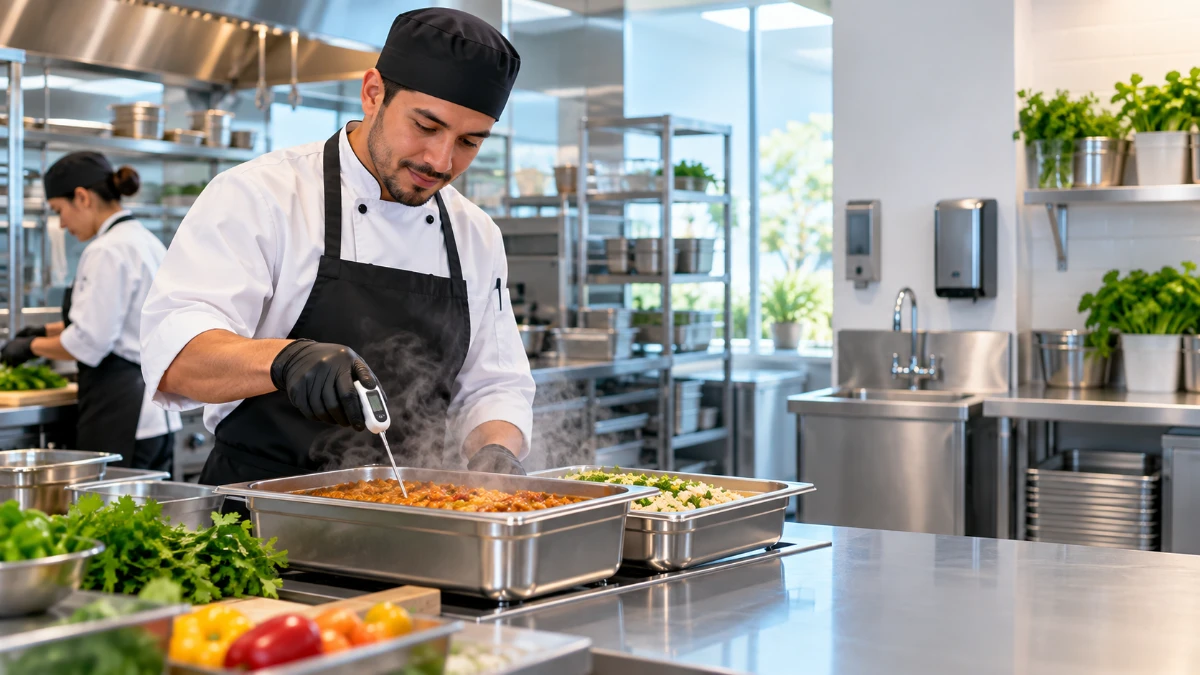
Food your kitchen cooked, cooled and stored must be reheated to 165°F for 15 seconds within 2 hours before it goes into hot holding. Commercially processed ready-to-eat food only needs 135°F. A steam table holds temperature and cannot do the reheating, so heat on the range, in an oven or in a steamer, probe the center, and only then transfer the food for holding.
Reheating is the last chance to catch what grew while a pan sat in the walk-in. Nobody sees it happen, and a pot of chili that has been reheated properly looks the same as one that has not. That is why the rule is written as a temperature, a hold time and a clock, and why ServSafe questions on it keep handing you all three. To see how well the numbers have stuck, the free Safe Service and Display of Food quiz covers the holding side that comes straight after reheating.
What is the reheating rule, and why is it 165°F?
The ServSafe Manager exam is 90 multiple-choice questions in two hours, but only 80 of them count. The other 10 are unscored pilot items the National Restaurant Association uses for research, and nothing on screen tells you which is which. You pass at 56 of the 80 scored questions — 70%, not the 75% most prep sites publish.
Our full-length ServSafe Manager practice tests copy that structure exactly: 90 questions, 10 unmarked pilot items, a two-hour countdown that submits at zero, and a result worked out of 80 against the same pass line. The seven content areas carry the real exam’s weights rather than an even split — Preparation and Cooking 15, Receipt and Storage 13, Hygiene and Health 12, Cleanliness and Sanitation 12, Facilities and Equipment 12, Management 8, Service and Display 8.
Cooking kills the pathogens present in raw food. Reheating is a different job. It deals with whatever survived or grew after the food was cooked, cooled, stored and handled again, and that is why the threshold for cooked-and-cooled food is 165°F held for 15 seconds, all reached within 2 hours. The 135°F hot-holding temperature keeps food safe once it is hot. It is not high enough to recover food that has been through a full cooling and storage cycle.
Cooked rice is the standard example. Cooking adds the moisture that dry rice lacked, and Bacillus cereus does well in rice held warm for too long. Cooked beans, stews, pasta dishes and sauces follow the same logic. They are TCS foods, which is covered in the guide to which foods count as TCS, and they carry the most handling history by the time they are reheated.
Which reheating target applies to which food?
The number depends on where the food came from and what you plan to do with it. That is the single most useful thing to get straight, because it is the line exam questions try to blur.
| Food | Going into hot holding? | Reheat to | Time limit |
|---|---|---|---|
| Yesterday’s chili, cooked and cooled in your kitchen | Yes | 165°F for 15 seconds | Within 2 hours |
| Cooked rice or beans held in your walk-in | Yes | 165°F for 15 seconds | Within 2 hours |
| Banquet leftovers that were cooled and stored correctly | Yes | 165°F for 15 seconds | Within 2 hours |
| Canned soup or a processed sauce, ready to eat | Yes | 135°F | Not the same clock, because it was processed to be safe |
| Anything already hot and in a steam well | Already holding | Keep at 135°F or higher | Holding, not reheating |
If a question gives you both a house-made item and a commercial item in the same kitchen, both targets can be right on the same shift. Read the food’s history, and the pot it happens to be in stops mattering.
Why can’t a steam table do the reheating?
Steam tables, bain-maries, warmers and hot-holding cabinets are built to keep hot food hot. They add heat gently, which is exactly right for soup that is already at 135°F or above and exactly wrong for a cold stockpot. A pan of stew put in a steam well at the start of the shift looks hot on top within the hour, while the center stays in the 41°F to 135°F danger zone for much longer. Hot-holding equipment maintains temperature rather than raising it.
The fix is a sequence: reheat first in equipment that can move food through the danger zone quickly, confirm 165°F with a probe, then move the food to the steam table. Mistakes here usually happen in the first hour of the day, when prep is rushed and the warm well looks like a shortcut.
How does the two-hour clock work?
Two hours is the time allowed for the whole reheat, and it starts running before the pan is hot. Food that creeps up over four hours has spent four hours in the danger zone, and arriving at 165°F at the end does not cancel that time. The danger zone limit is 4 hours cumulative from receiving through service, and slow reheating eats into the same budget.
That is why batch size matters as much as the burner. A five-gallon container of chili reads 165°F at the edge long before the center agrees. Smaller batches, shallow pans and regular stirring are the practical tools that keep a reheat inside two hours.
Which equipment reheats food fast enough?
| Equipment | Reheats? | What to watch |
|---|---|---|
| Range or stovetop | Yes | Stir often so the pan wall does not read higher than the center |
| Oven | Yes | Use shallow pans. Deep pans heat from the outside in and run slowly |
| Steamer or steam-jacketed kettle | Yes | Check the center of the product, not the steam |
| Microwave | Yes, with care | Cover, stir partway, rotate, let stand, and probe more than one spot |
| Steam table or bain-marie | No | Holding only. Food goes in after it reaches 165°F |
| Hot-holding cabinet or warmer | No | Holding only. Preheat it before loading |
| Slow cooker or chafing dish | No | Too slow to move cold food through the danger zone |
What are the most common reheating mistakes?
| Mistake | Why it fails | Fix |
|---|---|---|
| Cold soup straight into the steam well | Equipment holds, it does not raise | Reheat on the range, then transfer |
| One deep container of chili | The center misses the two-hour limit | Divide into shallow pans or smaller batches |
| Checking one spot near the edge | The edge reads high while the center lags | Stir, then probe the center and a second spot |
| Trusting steam or bubbling | Appearance is not a temperature | Use a calibrated probe thermometer |
| Topping off an old pan with fresh food | Mixes two different times and temperatures | Replace the pan instead |
| Applying 135°F to house-made leftovers | That target is for commercially processed food | Use 165°F for 15 seconds within 2 hours |
| Reheating food that was never cooled properly | Reheating does not repair a failed cooling step | Check the cooling record, and discard if it failed |
The last row deserves attention. If the food sat out past the cooling limits, reheating to 165°F is not a rescue. The two-stage cooling rule runs from 135°F to 70°F within 2 hours and then from 70°F to 41°F or lower within a further 4 hours, and a reheat inherits whatever happened there.
How does reheating fit with cooling and holding?
Reheating is one step in a chain, and each link has its own number. Reading the chain in order is the easiest way to keep the figures straight.
| Step | Requirement |
|---|---|
| Cooling, stage 1 | 135°F to 70°F within 2 hours |
| Cooling, stage 2 | 70°F to 41°F or lower within a further 4 hours |
| Cold storage | 41°F or lower |
| Reheating for hot holding | 165°F for 15 seconds, within 2 hours |
| Reheating commercially processed ready-to-eat food | 135°F |
| Hot holding | 135°F or higher |
For the holding end of the chain, the comparison of hot holding versus cold holding goes through the equipment and the checks. The full picture of the range that sits underneath all of these numbers is in the explainer on the food danger zone.
How is reheating tested on the Manager exam?
Reheating has no content area of its own. It sits inside Safe Preparation and Cooking of Food, alongside cooking temperatures, cooling and thawing, and the hot holding that follows belongs to Safe Service and Display of Food.
| Content area | Scored questions | Reheating-related ground |
|---|---|---|
| Safe Preparation and Cooking of Food | 15 | Reheating targets, equipment, cooling before the reheat |
| Safe Service and Display of Food | 8 | Hot holding after reheating, transfer to holding equipment |
| Management of Food Safety Practices | 8 | Monitoring, records, corrective action |
Questions usually give you a food, a piece of equipment and a clock, then ask what went wrong. Read the food’s history first, pick the target from that, and then check whether the equipment could have hit it in time.
A worked question
A cook puts a cold pan of beef stew, cooked and cooled in the kitchen the day before, into the steam table at 9:00 a.m. for service at 11:30 a.m. What is the main problem?
- A. The stew should have been reheated to 135°F, the hot-holding temperature
- B. The stew was put into equipment that holds temperature and cannot do the reheating
- C. The stew should not have been placed in the steam table before 11:30 a.m.
- D. Nothing is wrong as long as the steam table lid stays on
Correct answer: B. A steam table keeps hot food hot. It does not raise cold food through the danger zone quickly enough, so the stew may not reach 165°F for 15 seconds within 2 hours. The stew should have been reheated on the range or in an oven first, probed, and then moved to the steam table.
Why A is tempting and wrong. 135°F is the hot-holding number, and it is also the reheating target for commercially processed ready-to-eat food. House-made stew that has been cooled and stored is held to 165°F for 15 seconds within 2 hours. The question tests whether you matched the target to the food’s history.
Why D is wrong: a lid traps heat in a hot well, but it does nothing for the speed of the reheat.
To check the pattern in a wider mix of questions, the ServSafe Manager practice questions bring reheating back in alongside everything else on the blueprint.
Frequently asked questions
What is the difference between reheating and hot holding?
Reheating raises cold, previously cooked food to a safe temperature. Hot holding keeps food that is already hot at 135°F or higher. They use different equipment and carry different targets. A steam table or hot-holding cabinet belongs to the second job only, and food goes onto it after reheating is finished.
Why does food that was already cooked need to reach 165°F?
Cooking once does not protect food against what happens afterward. Cooked food that is cooled, stored and handled can pick up bacteria or let survivors grow, and cooked rice is a known carrier of Bacillus cereus. The 165°F target for 15 seconds is higher than the 135°F holding temperature to cover that extra handling history.
What makes leftover soup riskier to reheat than a grilled chicken breast?
Soup is thick, liquid and usually stored in volume, so heat reaches the center slowly and unevenly. A chicken breast is thin enough to probe and finish quickly. Soups, chili, gravies and sauces are where the two-hour limit gets missed, because the edges look ready while the center is still in the danger zone.
Why does the two-hour limit matter if the food reaches 165°F in the end?
A good final reading does not erase time already spent in the danger zone. Food that creeps up over four hours has spent four hours between 41°F and 135°F, and reaching 165°F at the end does not undo that. The rule measures how fast you got there as well as where you finished.
Where do you put the thermometer when reheating chili or soup?
Put the probe in the center of the pot, away from the pan wall, and take a second reading in a different spot after stirring. The edge heats first and reads high, while the center lags. The center reading decides whether the batch has reached 165°F, and it needs to hold there for 15 seconds.
What equipment should you reheat food in?
Use equipment that raises temperature quickly: a range, an oven, a steamer, or a microwave used with stirring. Steam tables, bain-maries, hot-holding cabinets and slow cookers are holding equipment. They keep hot food hot and are too slow to move a cold pan through the danger zone within two hours.
Can a slow cooker or chafing dish reheat food?
No. Slow cookers and chafing dishes add heat gently and are built to hold food that is already hot. A cold pan on one can spend hours in the danger zone. Reheat on the range, in an oven or in a steamer to 165°F first, then move the food across for holding at 135°F or higher.
Can you reheat food in a microwave in a commercial kitchen?
Yes, provided every part of the food reaches the required temperature. Microwaves heat unevenly, so cover the container, stir partway through, rotate it, and let it stand before you probe. Check more than one spot. A bowl of soup can boil at the edge while the center is still cold.
Can you reheat the same food more than once?
The rules set a target for each reheat, but every extra cycle means another round of cooling that has to meet the 135°F to 70°F in 2 hours and 70°F to 41°F in a further 4 hours sequence. Each cycle adds time in the danger zone and costs quality. Plan batches so you reheat only what you will serve.
How do I know whether the 165°F or 135°F target applies?
Ask where the food came from. If your kitchen cooked it, cooled it and stored it, the target is 165°F for 15 seconds within 2 hours. If it is commercially processed, ready-to-eat food, such as canned soup going into a hot well, the target is 135°F. The food’s history decides the number, and appearance has no say.
Who should verify reheating temperatures during a shift?
The person in charge of the shift should verify them with a calibrated probe thermometer, and a manager should review the records. Assigning one named person removes the situation where everyone assumes someone else checked. It is an application of active managerial control: the check is scheduled and written down rather than left to habit.
What if reheated food does not reach 165°F within two hours?
Treat it as a failed batch. The standard was 165°F for 15 seconds within 2 hours, and continuing to heat does not recover the time already spent in the danger zone. Follow your operation’s written corrective action, and discard the food when you cannot show it met the limit. Then fix the method, such as using smaller batches.
Why should thick foods be stirred while reheating?
Stirring moves heat from the hot edge to the cold center. Thick foods such as chili, gravy, refried beans and cheese sauce heat in layers, and the pan wall can read 165°F while the middle sits far lower. Stir before you probe, so the reading reflects the whole batch instead of the warmest spot.
Can I use an infrared thermometer to check reheated food?
Not for the final check. An infrared thermometer reads surface temperature only, and a reheated pan is hottest at the surface and coolest at the center. Use a probe thermometer in the thickest or densest part of the food, and keep the infrared gun for quick checks of equipment and incoming packaging.
Can you top off a steam-well pan with a fresh batch?
Replace the pan instead. Adding fresh food to an older pan mixes two different times and temperatures, so you can no longer say how long any of it has been held. A fresh pan that has been reheated to 165°F and probed keeps a clean record and a clear discard time.
How do you safely reheat cooked rice?
Spread it in a shallow pan or divide it into small portions, add moisture if needed, and heat it until the center reaches 165°F for 15 seconds, all within 2 hours. Cooked rice is a TCS food. Rice that was not cooled within the cooling limits goes in the discard bin before reheating comes up.
How much food should I reheat at once?
Reheat what you can bring to 165°F within two hours and what you expect to serve. Large batches in deep containers miss the time limit, so divide them into smaller batches or shallow pans. Reheating in rounds through service also keeps food fresher than one big batch that sits in holding for hours.
What should a reheating log record?
Record the food, the time it left cold storage, the time heating started, the probe reading and the time it reached 165°F, the initials of the person who checked, and any corrective action. Those entries show an inspector that the two-hour limit was met and let a manager spot a slow method before it fails.
How is reheating tested on the ServSafe Manager exam?
Reheating sits inside Safe Preparation and Cooking of Food, which carries 15 of the 80 scored questions, and the hold that follows sits in Safe Service and Display of Food at 8. Expect scenarios that give you a food, a piece of equipment and a clock, then ask what the cook did wrong.
Does the Food Handler assessment cover reheating?
The Food Handler assessment has a Time and Temperature content area worth 8 of its 40 scored questions, and reheating belongs to that subject. ServSafe does not publish a topic-by-topic question list, so the number of reheating questions is not known. The pass mark is 30 of 40, which is 75%.
Where to go next
When the targets are clear and you want to find out whether they hold up across a full sitting, take a full-length Manager practice test. Twenty-five questions tells you what you know. Ninety tells you whether you can still read carefully at question 71 with 18 minutes left.
Reviewed 30 September 2026. Exam figures checked against the published ServSafe Manager content blueprint. Reheating, cooling and holding temperatures follow the FDA Food Code and were verified against FDA retail food protection guidance on 10 September 2026.