
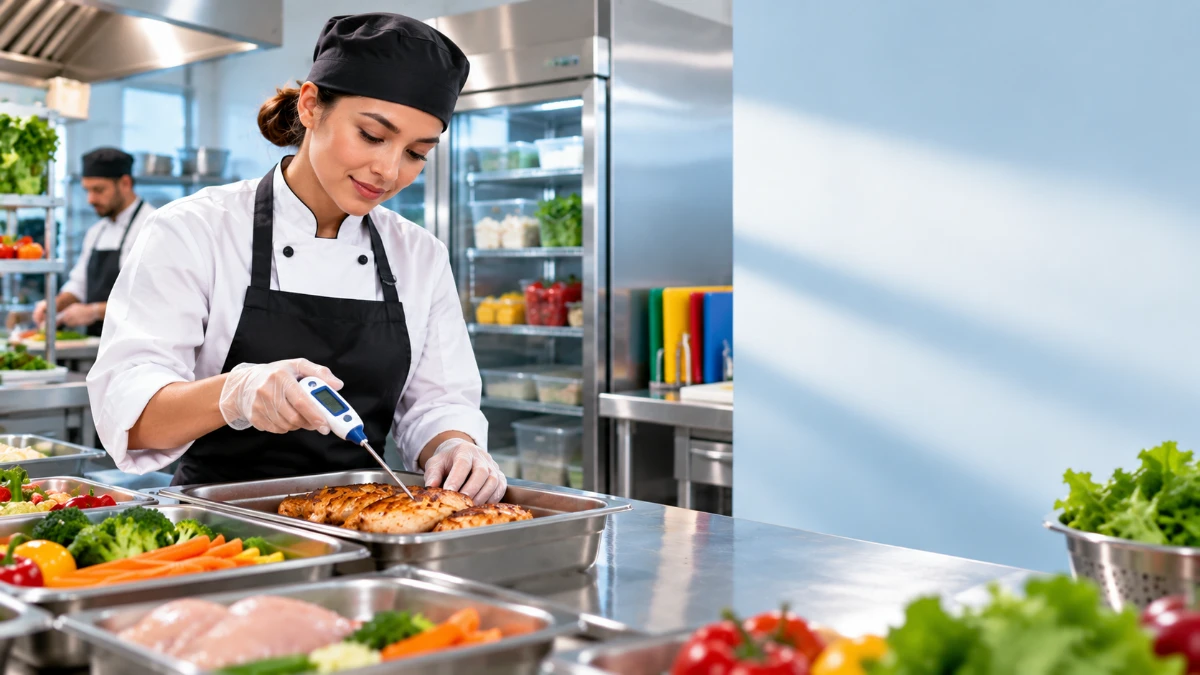
TCS foods are foods that need time and temperature control to stay safe — milk and dairy, meat, poultry, fish, shellfish, shell eggs, baked potatoes, heat-treated plant foods like cooked rice and beans, tofu, sprouts, cut melon, cut tomatoes, cut leafy greens, and untreated garlic-in-oil mixtures. Under the FDA Food Code they must be kept out of the 41°F to 135°F danger zone, cooled in two stages, and date-marked if held longer than 24 hours.
Unsafe food rarely announces itself. A pan of rice that has been sitting at 90°F since the lunch rush looks exactly like a pan of rice that has been held properly, and it smells the same too. That is the whole reason TCS rules exist: they replace judgement with numbers, because judgement cannot detect Bacillus cereus.
Cooling, reheating and date marking account for most of the marks lost on this topic and most of the violations written up in real kitchens, so they get the most room below.
The danger zone is 41°F to 135°F, not 40°F to 140°F
Start here. This is the most common source of confusion on the topic, and getting it wrong costs you marks on questions you actually understand.
There are two danger zones in circulation, and both are correct in different settings.
| Standard | Danger zone | Applies to | Time limit in the zone |
|---|---|---|---|
| FDA Food Code | 41°F to 135°F | Regulated foodservice and retail. This is the ServSafe figure | 4 hours cumulative, receiving through service |
| USDA consumer guidance | 40°F to 140°F | Home kitchens and unregulated group settings | 2 hours, or 1 hour above 90°F |
The consumer range is deliberately wider. It buys a margin of safety for people without thermometers, walk-in coolers, or a manager checking temperature logs. The FDA’s own retail guidance puts the regulated figure plainly: the danger zone is usually between 41°F and 135°F, and the time food spends there has to be minimised by proper cooling.
If a practice question offers you 40°F to 140°F alongside 41°F to 135°F, it is testing whether you know which standard governs a commercial kitchen. It is 41 to 135.
What makes a food TCS
A food is TCS when it supports rapid bacterial growth or toxin formation if it is held at the wrong temperature for too long. Three conditions drive it: moisture, nutrients, and a pH that bacteria tolerate. Most foods that fail on all three are TCS.
Classification follows the state of the food. It moves. A whole melon is not TCS; a sliced melon is, because cutting breaks the rind that was keeping bacteria off the flesh. Dry rice is not TCS; cooked rice is, because cooking adds the moisture that was missing.
The useful exam habit is to ask what changed. Was the food cut, cooked, mixed, opened, or held for service? Each of those can move a food into TCS territory.
The standard TCS list
- Milk and dairy products
- Meat — beef, pork, lamb
- Poultry
- Fish
- Shellfish and crustaceans
- Shell eggs
- Baked potatoes
- Heat-treated plant foods such as cooked rice, beans and vegetables
- Tofu and other soy protein foods
- Sprouts and sprout seeds
- Sliced melons, cut tomatoes, cut leafy greens
- Untreated garlic-and-oil mixtures
Is it TCS? The foods that catch people out
Raw chicken is obvious. Dry pasta is obvious. The marks are lost in the middle, where the answer depends on what has been done to the food rather than what the food is.
| Food | TCS? | Why |
|---|---|---|
| Dry uncooked rice | No | Too dry to support growth |
| Cooked rice | Yes | Cooking adds the moisture that was missing |
| Dry beans | No | Same reason as dry rice |
| Cooked beans | Yes | Heat-treated plant food |
| Raw whole potato | No | Intact skin, low moisture at the surface |
| Baked potato | Yes | Cooked interior plus trapped moisture, especially if wrapped |
| Whole melon | No | The rind keeps bacteria off the flesh |
| Sliced melon | Yes | Cutting exposes the protected interior |
| Whole tomato | No | Intact skin |
| Cut tomato | Yes | Cutting changes it |
| Cut leafy greens | Yes | Cutting raises both risk and shelf-life concern |
| Pasteurised milk | Yes | Pasteurisation is not sterilisation. It still supports growth |
| Tofu | Yes | High moisture, high protein |
| Peanut butter | No | Too little available moisture |
| Shell eggs | Yes | Controlled storage and safe cooking both required |
| Sprouts | Yes | Grown in exactly the warm, wet conditions bacteria prefer |
| Untreated garlic in oil | Yes | Low-oxygen environment allows toxin formation |
| Plain bread | No | Low moisture, unless filled or topped with a TCS item |
| Cream-filled pastry | Yes | The filling drives the classification, not the pastry |
Mixed dishes take their classification from their riskiest component. A turkey sandwich is TCS because of the turkey, the cheese and the cut tomato. A burrito bowl is TCS several times over.
Every TCS temperature in one place
| Step | Requirement |
|---|---|
| Receiving cold TCS food | 41°F or lower |
| Receiving hot TCS food | 135°F or higher |
| Cold holding | 41°F or lower |
| Hot holding | 135°F or higher |
| Cooling, stage 1 | 135°F to 70°F within 2 hours |
| Cooling, stage 2 | 70°F to 41°F or lower within a further 4 hours |
| Total cooling time | 6 hours maximum |
| Reheating for hot holding | 165°F for 15 seconds, within 2 hours |
| Reheating commercially processed ready-to-eat food | 135°F |
| Date marking threshold | Ready-to-eat TCS food held more than 24 hours |
| Maximum date-marked life | 7 days at 41°F or lower, prep day counted as day 1 |
| Storage clearance | At least 6 inches off the floor |
Cooling: the rule that fails most often
Cooling is where good kitchens get caught, because it is the one step that happens after service, when everyone is tired and the shift is nearly over. A deep stockpot of chili put straight into the walk-in can hold its centre above 70°F for four hours and warm everything around it while it does.
The two-stage rule exists because bacteria grow fastest in the upper part of the danger zone. Get through that part quickly and the rest is comparatively safe:
- 135°F to 70°F within 2 hours. This is the stage that matters.
- 70°F to 41°F or lower within the next 4 hours.
If the food does not reach 70°F within the first two hours, the corrective action is to reheat it to 165°F for 15 seconds and start cooling again. If you cannot do that, discard it.
Note the detail most study guides skip: if 70°F is reached early, the unused time rolls into the second stage. Reaching 70°F in one hour leaves you five hours to get to 41°F, not four. The six-hour total is what governs.
Methods that work: divide into smaller portions, shallow pans, ice-water bath, ice paddle, ice as a recipe ingredient, blast chiller. Methods that do not: a lid, a deep container, and optimism.
For the full sequence, see cooling food safely.
Reheating is not cooking, and the numbers differ
Cooking kills pathogens present in raw food. Reheating deals with whatever grew during storage, which is a different job with a different threshold.
TCS food that will be hot-held must be reheated to 165°F for 15 seconds, within 2 hours. The two-hour limit is the part people forget. Food creeping up to temperature over four hours in a steam well has spent four hours in the danger zone, and reaching 165°F at the end does not undo that.
Commercially processed ready-to-eat food, such as canned soup going into a hot well, only needs 135°F, because it was already processed to be safe.
Hot-holding equipment holds temperature rather than raising it. Reheat in an oven, a steamer or on the range, then transfer. More detail in reheating food safely.
Date marking and the day-1 rule
Ready-to-eat TCS food held longer than 24 hours must be date-marked. Held at 41°F or lower, it gets a maximum of seven days, and the day of preparation or opening counts as day 1.
Make tuna salad on Monday and Monday is day 1. The last day you can serve it is Sunday. People lose this question by counting from Tuesday.
When ingredients with different dates are combined, the earliest date carries. Chicken cooked Tuesday and mixed into a salad on Thursday gives the salad a Tuesday-based discard date. The shortest-lived component sets the limit, which is the same principle that governs classification.
How TCS is actually tested
Worth knowing before you plan your study time: TCS has no content area of its own on the ServSafe Manager exam. Its rules are tested inside three of the seven, which is why it feels like it comes up constantly.
| Content area | Scored questions | TCS content it carries |
|---|---|---|
| Safe Preparation and Cooking of Food | 15 | Cooking temperatures, cooling, reheating, thawing |
| Safe Receipt, Storage, Transportation and Disposal of Food | 13 | Receiving temperatures, storage order, date marking |
| Safe Service and Display of Food | 8 | Hot and cold holding, time as a public health control |
| Total | 36 of 80 | 45% of the scored exam |
Not every one of those 36 questions is about a TCS temperature. But every one of them sits in an area where the TCS rules are the underlying logic, which makes this the highest-return topic on the syllabus. Nothing else you can study returns 45% of the paper.
The ServSafe Manager exam is 90 multiple-choice questions in two hours, but only 80 of them count. The other 10 are unscored pilot items the National Restaurant Association uses for research, and nothing on screen tells you which is which. You pass at 56 of the 80 scored questions — 70%, not the 75% most prep sites publish.
Our full-length ServSafe Manager practice tests copy that structure exactly: 90 questions, 10 unmarked pilot items, a two-hour countdown that submits at zero, and a result worked out of 80 against the same pass line. The seven content areas carry the real exam’s weights rather than an even split. Every question is original, written to the published course objectives. No live exam content is reproduced here.
A worked question
A cook portions a 6-gallon batch of chili into a single deep container at 4:00 p.m. At 6:00 p.m. the centre reads 92°F. What should the manager do?
- A. Move it to the walk-in and check again in two hours
- B. Add ice to bring the temperature down and continue cooling
- C. Reheat to 165°F for 15 seconds and begin cooling again
- D. Discard the chili
Correct answer: C. The first cooling stage requires 135°F to 70°F within two hours. Two hours have passed and the chili is at 92°F, so stage one has failed. The Food Code corrective action is to reheat to 165°F for 15 seconds and restart cooling with a method that will actually work this time: shallow pans, an ice bath, smaller portions.
Why D is tempting and wrong. Discarding feels like the safe, responsible answer, and on an exam that rewards caution it looks right. But the food is still recoverable here, and the Code provides a defined corrective action. Discarding is what you do when reheating is not possible, or when the deviation is worse than this one. Picking D means you knew there was a problem but not what the rule says to do about it, which is exactly the distinction the question is testing.
Why A is wrong: it does nothing about a failure that has already occurred, in the same container that caused it.
To drill this pattern, the time and temperature practice test is free and covers the topic in isolation, and the ServSafe Manager practice test mixes it back in with everything else.
Frequently asked questions
What does TCS stand for?
TCS stands for Time and Temperature Control for Safety. It describes foods that need time and temperature managed to prevent bacterial growth or toxin formation. It replaced the older term “potentially hazardous food” in the FDA Food Code.
What is the temperature danger zone for TCS food?
41°F to 135°F under the FDA Food Code, which is the figure used in commercial foodservice and on ServSafe exams. USDA consumer guidance uses a wider 40°F to 140°F range for home kitchens. If you are working in or studying for foodservice, use 41 to 135.
Why do some sources say 40°F to 140°F?
Because they are quoting USDA consumer education rather than the FDA Food Code. The consumer range is deliberately wider to give a safety margin to people without commercial equipment or temperature monitoring. Both are correct in their own context.
How long can TCS food stay in the danger zone?
In regulated foodservice, four hours cumulative from receiving through service. Consumer guidance is stricter at two hours, or one hour above 90°F. Cooking a food to its minimum internal temperature resets the four-hour clock.
Is cooked rice a TCS food?
Yes. Cooking adds moisture to a food that was previously too dry to support bacterial growth, and cooked rice is a classic vehicle for Bacillus cereus when held warm too long. Dry uncooked rice is not TCS.
Is cut fruit always TCS?
No. Cut melon, cut tomatoes and cut leafy greens are specifically treated as TCS. Other cut fruits generally are not. The principle is that cutting removes a protective barrier.
Why is a baked potato TCS but a raw potato is not?
Baking cooks the interior and, if the potato is wrapped, traps moisture and heat inside it. That combination supports bacterial growth, including Clostridium botulinum in the low-oxygen environment under foil. A raw potato’s intact skin and lower surface moisture make it much lower risk.
Is peanut butter a TCS food?
No. Peanut butter has very little available moisture, which is why it sits on a shelf rather than in a cooler. Water activity is what governs here, and peanut butter has almost none.
Why is garlic in oil treated as TCS?
Oil excludes oxygen, and untreated garlic can carry Clostridium botulinum spores. A low-oxygen, low-acid environment at room temperature is where those spores produce toxin. Commercially prepared garlic-in-oil mixtures are acidified to prevent this.
What is the two-stage cooling rule?
Cool from 135°F to 70°F within two hours, then from 70°F to 41°F or lower within a further four hours. Total maximum cooling time is six hours. The first stage is the critical one because bacteria grow fastest in that range.
What if food does not reach 70°F within the first two hours?
Reheat it to 165°F for 15 seconds and start cooling again with a faster method. If reheating is not practical, discard it. Continuing to cool a batch that has already failed stage one is not an acceptable corrective action.
What if food reaches 70°F faster than two hours?
The unused time carries into the second stage. Reach 70°F in one hour and you have five hours remaining to reach 41°F, not four. The six-hour total is what governs.
What temperature must TCS food be reheated to?
165°F for 15 seconds, within two hours, if the food will be hot-held. Commercially processed ready-to-eat food, such as canned soup going into a hot well, only needs 135°F because it was already processed to be safe.
Can I reheat food in a steam table?
No, unless the equipment is specifically designed for it. Hot-holding equipment maintains temperature rather than raising it, so food creeps up slowly and spends far too long in the danger zone. Reheat on the range, in an oven or in a steamer, then transfer.
What are the hot and cold holding temperatures?
Cold TCS food is held at 41°F or lower. Hot TCS food is held at 135°F or higher. Check with a calibrated thermometer rather than by touch, stir foods like soups so heat distributes evenly, and preheat hot-holding equipment before food goes in.
When does TCS food need to be date-marked?
When it is ready-to-eat and will be held for more than 24 hours. Held at 41°F or lower, it gets a maximum of seven days, with the day of preparation or opening counted as day 1.
How do I count the seven days?
The prep or opening day is day 1. Food prepared on Monday must be used or discarded by Sunday. Counting from the following day is the most common way to get this question wrong.
What happens when ingredients have different use-by dates?
The earliest date carries to the finished dish. Chicken cooked Tuesday and mixed into a salad on Thursday gives the salad a Tuesday-based discard date. The shortest-lived component sets the limit.
What is time as a public health control?
A documented exception that allows TCS food to be held without temperature control for a limited period. It requires written procedures, a marked discard time, and disposal once the time expires. It is a managed exception with strict limits and a paper trail.
How much of the ServSafe Manager exam covers TCS?
TCS is not a content area of its own. Its rules are tested inside Safe Preparation and Cooking (15 scored questions), Safe Receipt, Storage, Transportation and Disposal (13), and Safe Service and Display (8). That is 36 of the 80 scored questions, or 45% of the exam.
Where to go next
Related reading: the food danger zone explained, minimum internal cooking temperatures, hot holding vs cold holding, and how Manager exam questions test time and temperature.
When you want to find out whether the rules have actually stuck, take a full-length Manager practice test. Twenty-five questions tells you what you know. Ninety tells you whether you can still read carefully at question 71 with 18 minutes left.
Reviewed 10 September 2026 against the FDA Food Code and the ServSafe Manager 9th Edition content blueprint. Temperature and cooling figures verified against FDA retail food protection guidance.