
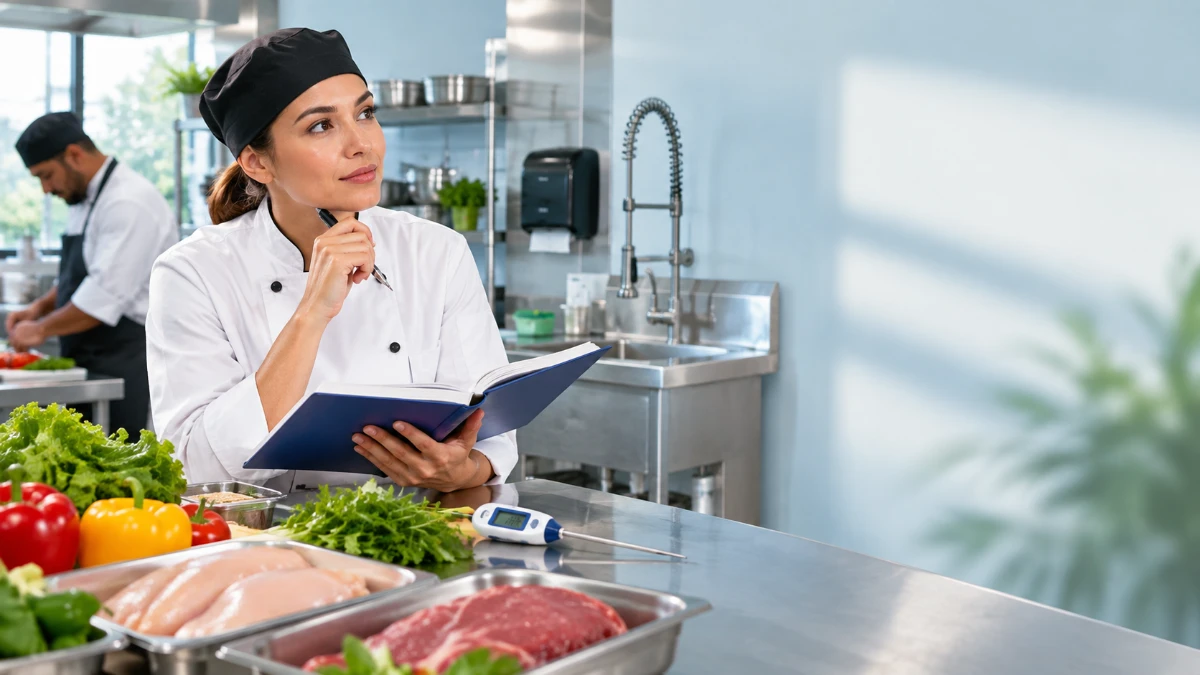
Every foodborne illness ServSafe tests traces back to one of three hazard types: biological, chemical, or physical. The exam cares less about pathogen names than about matching a symptom or scenario to the right control. Norovirus and Salmonella cause most of the outbreaks; time-temperature abuse and bare-hand contact cause most of the exposure. A candidate who can trace a scenario from symptom to source to control clears more questions than one who only memorized bacteria names.
Work through a set of ServSafe Manager practice questions and notice how often the question is really asking what you do next rather than which bacteria caused it.
What does foodborne illness actually mean on the ServSafe exam?
The ServSafe Manager exam is 90 multiple-choice questions in two hours, but only 80 of them count. The other 10 are unscored pilot items the National Restaurant Association uses for research, and nothing on screen tells you which is which. You pass at 56 of the 80 scored questions — 70%, not the 75% most prep sites publish.
Our full-length ServSafe Manager practice tests copy that structure exactly: 90 questions, 10 unmarked pilot items, a two-hour countdown that submits at zero, and a result worked out of 80 against the same pass line. The seven content areas carry the real exam’s weights rather than an even split — Preparation and Cooking 15, Receipt and Storage 13, Hygiene and Health 12, Cleanliness and Sanitation 12, Facilities and Equipment 12, Management 8, Service and Display 8.
In food service, foodborne illness means a disease carried or transmitted to people by food. ServSafe expects you to go one step further: identify the type of hazard involved and match it to the correct prevention method. For the wider blueprint behind that expectation, the ServSafe Manager practice test hub covers all seven content areas the exam draws from.
| Hazard type | What it includes | Typical source in a kitchen |
|---|---|---|
| Biological | Bacteria, viruses, parasites, and fungi or the toxins they produce | Undercooked food, sick workers, contaminated water |
| Chemical | Cleaners, sanitizers, polishes, toxic metals, pesticides | Poor storage, unlabeled containers, misuse |
| Physical | Glass, metal shavings, staples, bandages, dirt | Broken equipment, poor personal habits, packaging |
Most exam questions about foodborne illness land on the biological row, especially bacteria and viruses. Chemical and physical contamination still show up on inspections, usually traced to poor storage, poor labeling, or weak facility control.
ServSafe also draws a line between infection, intoxication, and toxin-mediated infection. Infection happens when a pathogen is eaten and then grows inside the body; Salmonella is the standard example. Intoxication happens when a toxin already present in the food is eaten, as with Staphylococcus aureus. Toxin-mediated infection happens when a pathogen is eaten and then produces toxins inside the body, the pattern associated with some Clostridium perfringens illness. The distinction has a practical consequence: when the danger is a toxin already formed in the food, reheating can kill the bacteria that made it without destroying the toxin itself. That is one reason time-temperature abuse carries so much weight on the exam.
What are the main types of foodborne illness a ServSafe candidate needs to know?
A practical way to study this ground is by source and spread, since that is also how the exam frames control measures.
Bacterial illness
Bacteria are living organisms that multiply fast in TCS food, especially once it sits in the danger zone too long. Salmonella tracks to poultry, eggs, and produce; Shiga toxin-producing E. coli to ground beef and contaminated produce; Listeria monocytogenes to deli meats and soft cheeses, and it is the one that keeps growing under refrigeration; Campylobacter to poultry and unpasteurized milk; Clostridium perfringens to large batches of meat, poultry, and gravy cooled or held incorrectly; Staphylococcus aureus to food handled after cooking, carried on hands, hair, and infected cuts; Bacillus cereus to rice, pasta, and other starchy foods left at unsafe temperatures. The control for all of it is the same idea applied consistently: manage time and temperature, stop cross-contamination, enforce handwashing, and exclude or restrict workers when required.
Viral illness
Viruses need a living host to reproduce, unlike bacteria, and in a restaurant that host is usually a person. Norovirus is the leading cause of foodborne illness outbreaks, typically spread by an infected worker, bare-hand contact with ready-to-eat food, or a contaminated surface. Hepatitis A spreads through the fecal-oral route, most often through poor handwashing. Because the source is a person rather than the food itself, prevention leans on employee health policy, correct handwashing, and no bare-hand contact with ready-to-eat items. One worker with one bad habit can contaminate a full shift’s worth of salads or sandwiches.
Parasitic illness
Parasites need a host to reproduce and typically trace to seafood, wild game, or produce touched by contaminated water. Anisakis simplex comes from raw or undercooked fish; Cyclospora and Giardia from contaminated water and produce. Prevention runs through approved suppliers, correct cooking, freezing fish when parasite destruction requires it, and safe produce handling.
Fungal and natural toxins
Some hazards come from a toxin rather than a live pathogen spreading through the kitchen: mold toxins from poor storage, toxic wild mushrooms, ciguatera and other seafood toxins that survive normal cooking, and certain plant toxins in improperly prepared beans. Sourcing and correct preparation control these hazards rather than temperature. That distinction matters on the exam, where a scenario question may expect you to rule cooking out as the answer.
Chemical contamination
Cleaners stored above food, unlabeled spray bottles, food kept in a chemical container, over-applied sanitizer, and toxic metals leaching from an unsafe container are the recurring causes. Clear labeling, separate storage, and food-safe containers only are the fix.
Physical contamination
Glass from a broken light or dish, metal shavings from damaged equipment, hair, nails, jewelry, bandages, and packaging material are the usual suspects, and they typically point back to poor personal habits or weak equipment maintenance.
How does foodborne illness actually spread in a working kitchen?
The exam tests the route of contamination more than the disease name. Once the route is clear, the right control follows.
- Person to food: poor handwashing, bare-hand contact, coughing, sneezing, working while sick
- Food to food: cross-contamination, such as raw chicken dripping onto lettuce
- Equipment to food: dirty knives, cutting boards, slicers, towels, prep tables
- Water to food: contaminated ice, produce rinsed in unsafe water, shellfish from unsafe waters
- Time-temperature abuse: conditions that let pathogens grow or toxins form
ServSafe expects each route matched to its control. If the route is a sick worker touching ready-to-eat food, the fix is exclusion or restriction, correct handwashing, and gloves or utensils. The contamination happened after the food was already cooked, so extending cook time changes nothing about that exposure.
Which symptoms and foods should worry a manager most?
Symptoms matter because they trigger reporting and exclusion rules under the exam’s employee health requirements.
| Symptom | Primary concern | Required response |
|---|---|---|
| Vomiting or diarrhea | Norovirus and other fecal-oral pathogens | Exclude from handling food |
| Jaundice | Hepatitis A (reportable) | Exclude and report to the regulatory authority |
| Sore throat with fever | Elevated risk, especially serving high-risk populations | Restrict or exclude per policy |
| Infected cuts or boils | Staphylococcus aureus contamination | Cover completely or reassign duties |
High-risk foods repeat on both inspections and exam questions because they support pathogen growth or are commonly served raw or lightly cooked: meat, poultry, eggs, and seafood; milk and dairy; cooked rice, beans, and vegetables; baked potatoes; tofu and soy protein; sliced melon, cut tomatoes, and leafy greens; and any ready-to-eat food handled after cooking. The controls that matter are cooking to the required internal temperature, holding hot food hot and cold food cold, cooling quickly enough to outrun bacterial growth, reheating correctly, handwashing, cleaning and sanitizing food-contact surfaces, buying from approved sources, and enforcing exclusion and restriction policies.
What do outbreak-style scenarios on the exam actually look like?
These mirror both exam wording and real inspection failures.
The salad station
A prep worker comes in with diarrhea because the shift is short-staffed, rinses their hands quickly, and assembles sandwiches and salads. Two days later, guests report vomiting and cramps. A sick worker contaminated ready-to-eat food, and norovirus needs only a small amount of contamination to spread. The fix: enforce illness reporting, exclude the worker, full handwashing, no bare-hand contact with ready-to-eat food, and proper cleaning and sanitizing.
The banquet gravy
A large batch of roast beef and gravy is cooked correctly, then left too long during cooling, reheated the next day, and served. Guests develop cramps and diarrhea. Conditions favored a spore-forming organism such as Clostridium perfringens. The fix: cool in shallow pans or smaller portions, use ice baths or blast chilling where available, monitor time and temperature during cooling, and reheat and hold properly.
The undercooked burger
A rushed cook serves a burger that never reached the required internal temperature, and a guest later tests positive for E. coli. Ground beef carries elevated risk because grinding can mix bacteria throughout the product rather than leaving it on the surface, where cooking would reach it first. The fix: cook to the required temperature, verify with a calibrated thermometer instead of color, and keep raw meat away from ready-to-eat items.
The chemical mix-up
A line worker stores an unlabeled spray bottle next to sauces, and another worker mistakes it for water near exposed food. The fix: label every chemical, store away from food and food-contact items, and train staff to never use an unknown container’s contents.
The sushi risk
An operation serves raw fish from an unverified source with no parasite-destruction records. The fix: buy from approved, reputable suppliers, verify freezing requirements when they apply, and keep records where required.
How do the major pathogens compare at a glance?
| Pathogen | Source | Common foods | Main prevention |
|---|---|---|---|
| Norovirus | Infected people | Salads, sandwiches, cut fruit | Exclude ill workers, handwashing, no bare-hand contact |
| Hepatitis A | Infected people, contaminated water | Ready-to-eat food, shellfish from unsafe waters | Employee health policy, handwashing, approved source |
| Salmonella | Animals, humans | Poultry, eggs, meat, produce | Correct cooking, prevent cross-contact, handwashing |
| E. coli (STEC) | Cattle intestines, contaminated water | Ground beef, leafy greens | Correct cooking, approved source, cross-contamination control |
| Clostridium perfringens | Soil, intestines | Meat, poultry, gravy | Cool quickly, hold safely, reheat correctly |
| Staphylococcus aureus | Human skin, nose, infected wounds | Deli meats, salads, bakery items | Personal hygiene, wound coverage, time-temperature control |
| Anisakis | Infected fish | Sushi, ceviche, raw fish dishes | Approved source, freezing when required |
What prevention habits actually interrupt transmission?
- Exclude or restrict sick workers per policy, regardless of how short-staffed the shift is
- Wash hands correctly and often, especially after the restroom, raw food, or a task change
- Use gloves or utensils for ready-to-eat food
- Keep storage, prep areas, and tools separated to stop cross-contamination
- Cook to required internal temperatures and verify with a thermometer
- Hold hot food hot and cold food cold, outside the danger zone
- Cool and reheat using approved time-temperature methods
- Clean and sanitize food-contact surfaces on schedule
- Buy only from approved, reputable suppliers
- Label and store chemicals away from food and equipment
How should you actually study this topic for the exam?
Do not memorize disease names in isolation. Study each one as a set of five linked facts: the source, how it spreads, the warning signs, the high-risk foods involved, and the control that fits. Most exam questions are written as situations rather than flashcards: what should a manager do when a food handler has jaundice, why did a batch of chili make guests sick, which item needs parasite-destruction records. Once the pattern is familiar, the correct answer stops being a guess.
The fastest way to test that pattern is against the full 90-question Manager practice exam, which forces the same symptom-to-source-to-control reasoning the real exam uses rather than isolated recall. If you are still deciding how much runway to give yourself before test day, how long you should actually study before a ServSafe class or exam lays out a realistic timeline. TCS foods sit close enough to this topic that the complete guide to TCS foods and the temperature danger zone is worth reading alongside it, and the questions first-time ServSafe test takers ask most covers the logistics side this post does not.
FAQs
What is the difference between a foodborne infection and an intoxication?
An infection happens when a pathogen is eaten and then grows inside the body, the way Salmonella does. An intoxication happens when a toxin the pathogen already produced is eaten directly, the way Staphylococcus aureus toxin works. The distinction changes how prevention works: killing the pathogen with heat does not always destroy a toxin it already made.
What is a toxin-mediated infection, and which pathogen is the textbook example?
A toxin-mediated infection happens when a pathogen is eaten, survives, and then produces toxins inside the body rather than in the food beforehand. Some Clostridium perfringens illness follows this pattern. It sits between a straightforward infection and a straightforward intoxication, which is exactly why exam questions test it separately from the other two.
Which foodborne bacteria can grow even inside a properly cold refrigerator?
Listeria monocytogenes is the standout example. Most bacteria slow down sharply below 41°F, but Listeria keeps multiplying at refrigeration temperatures, which is why it tracks so consistently to deli meats and soft cheeses held cold for days. Correct cold-holding temperatures slow it but do not stop it the way they stop most other bacteria.
Why is norovirus called the leading cause of foodborne illness outbreaks?
Norovirus spreads from a very small amount of contamination and survives on hands and surfaces long enough to reach dozens of servings from one exposure. Because it comes from infected people rather than raw ingredients, an operation can source every item correctly and still have an outbreak if one sick worker touches ready-to-eat food.
Which symptoms require a food worker to stop handling food immediately?
Vomiting, diarrhea, jaundice, sore throat with fever, and infected wounds or boils with pus all trigger exclusion or restriction under ServSafe’s employee health rules. Jaundice carries the most weight because it is the visible sign of hepatitis A, which regulations treat as reportable to the health department.
Why is jaundice treated as more serious than other reportable symptoms?
Jaundice is one of the clearest external signs of hepatitis A, a virus that spreads through the fecal-oral route and can move through a kitchen before anyone realizes it. Because hepatitis A has a real incubation period, jaundice showing up later still points back to exposure that already happened, which is why it triggers mandatory exclusion and reporting rather than a judgment call.
Does cooking always neutralize a foodborne illness risk?
No. A preformed toxin from Staphylococcus aureus, certain seafood toxins like ciguatera, and chemical contamination all survive normal cooking heat. Cooking controls live pathogens present in the food at the time of cooking; it does not undo contamination that happens afterward or a toxin that formed before the food ever reached the heat.
Which foods come up most often in foodborne illness exam questions?
Poultry, eggs, ground beef, seafood, deli meats, salads, cut produce, cooked rice, and gravies dominate because they either support pathogen growth as TCS foods or are commonly served raw or lightly cooked. Recognizing a food on this list is usually the first clue in a scenario question about what went wrong.
How does Clostridium perfringens spread differently than norovirus?
Clostridium perfringens comes from soil and intestinal sources and grows when large batches of meat, poultry, or gravy cool or hold too slowly, so the failure is almost always a time-temperature problem in the kitchen. Norovirus comes from infected people and spreads through contact, so the failure is almost always a hygiene or exclusion problem. The exam expects you to tell these apart by cause, not just by symptom.
Why is ground beef treated as riskier than a whole cut of steak?
Grinding mixes any surface bacteria throughout the entire product, so a pathogen that would normally sit on the outside of a steak, where cooking reaches it first, can end up in the center of a burger patty. That is why ground meat needs a higher verified internal temperature than an intact cut of the same animal.
What is the fecal-oral route, and why does it matter in a restaurant?
The fecal-oral route means a pathogen travels from waste to hands to food to a new person, usually through skipped or incomplete handwashing. Hepatitis A and several bacterial illnesses spread this way, which is why proper handwashing after restroom use is treated as a control point rather than a courtesy.
Why does raw or undercooked fish carry a parasite risk that cooking usually removes?
Parasites such as Anisakis simplex live in the flesh of some fish species, and standard cooking temperatures destroy them along with most bacteria. Dishes served raw or lightly cured skip that step entirely, which is why approved sourcing and documented freezing for parasite destruction take the place cooking would normally play.
Can chemical contamination make someone sick with no bacteria or virus involved?
Yes. An over-applied sanitizer, a cleaner stored above food, or food kept in a container that once held chemicals can cause illness or injury on its own, with no pathogen anywhere in the chain. Labeling, separate storage, and food-safe containers are the entire control, since neither cooking nor cooling addresses a chemical hazard.
What are examples of physical hazards that don’t involve any pathogen at all?
Glass from a broken light or dish, metal shavings from worn equipment, hair, jewelry, bandages, and stray packaging material are all physical hazards with no biological cause. They usually trace back to equipment maintenance or personal habits rather than time, temperature, or sourcing.
Why do some seafood and mushroom toxins survive normal cooking temperatures?
Toxins like ciguatera in reef fish or the toxins in poisonous wild mushrooms are chemically stable at temperatures that kill bacteria and viruses without issue. Since heat does not break them down, the only real control is sourcing: approved suppliers, correct species identification, and avoiding foraged or unverified ingredients.
What is the difference between contamination and a confirmed foodborne illness?
Contamination means a hazard has gotten into the food, whether or not anyone gets sick from it. A foodborne illness means that contamination actually reached someone and caused symptoms. Every food safety system is built to catch contamination long before it has the chance to become an illness.
Why is a sick worker a bigger viral risk than the raw food itself?
Viruses like norovirus and hepatitis A need a living host to spread, and in a restaurant that host is almost always a person rather than an ingredient. A fully approved, correctly cooked menu can still cause an outbreak if one infected worker touches ready-to-eat food, which is why employee health policy carries as much weight as sourcing and cooking combined.
What is the very first step when a worker reports vomiting or diarrhea before a shift?
The worker is excluded from food handling immediately, before any discussion of how busy the shift is. ServSafe treats this as a fixed rule rather than a judgment call, because norovirus and similar pathogens need only minimal contamination to reach dozens of guests through one shift’s ready-to-eat items.
How should a manager investigate a complaint that points to a specific meal?
Start with what was served, when it was cooked, held, and reheated, and whether any worker reported symptoms around that shift. Matching the timeline against known incubation periods for likely pathogens usually narrows the cause faster than testing the food itself, and it points straight to which control point actually failed.
Why does the ServSafe exam test contamination routes instead of just pathogen names?
Knowing that Salmonella exists does not tell you what to do about it. Knowing that the route was an infected worker touching ready-to-eat food tells you exactly which control applies. The exam is built to check judgment under a scenario, which is why route-and-control questions outnumber simple identification questions by a wide margin.
Reviewed 30 September 2026 against ServSafe’s Manager Content Blueprint and the program’s published pass mark, question count, and content-area weighting.