
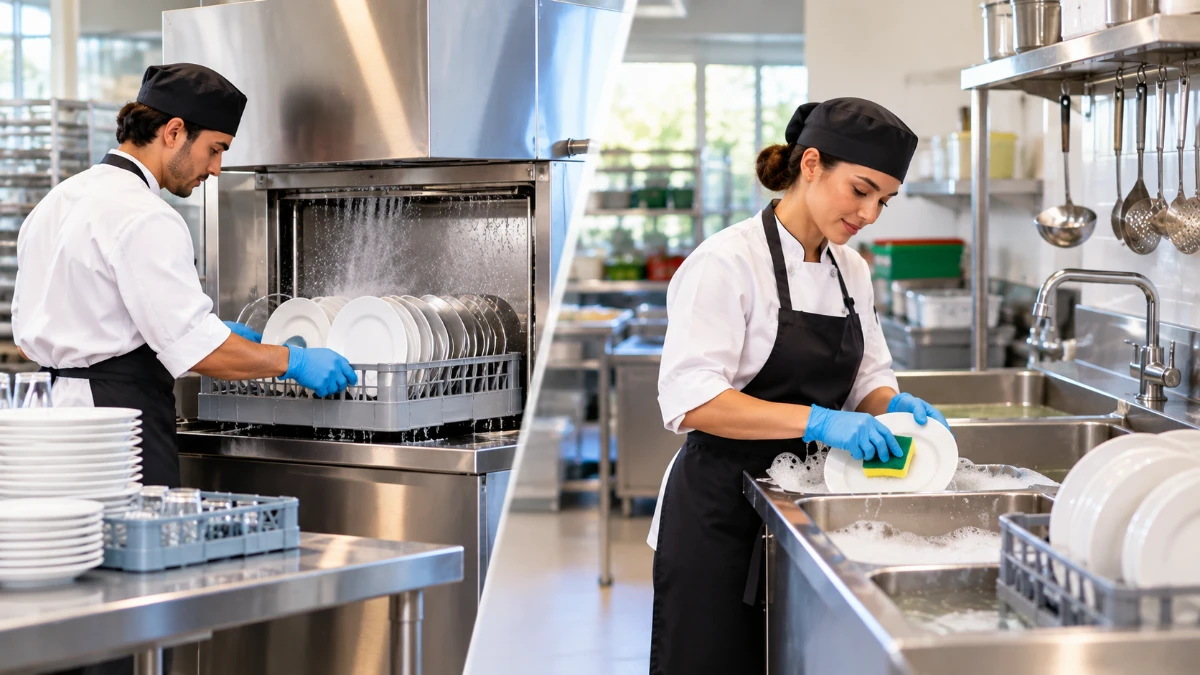
A commercial dishmachine and a three-compartment sink both meet code, and the one that passes inspection is the one you can prove worked. Code asks for a cleaned surface that then reaches the sanitizing condition, whether that is final-rinse heat, a chemical at label strength, or sink contact time. Pick the method for your volume and layout, then verify it every shift and write it down.
If you want to drill the sanitation questions while you read, the free Cleanliness and Sanitation drill covers warewashing on its own.
Most arguments about dishmachines versus sinks are really arguments about trust. A machine feels trustworthy because it repeats a cycle, and a sink feels risky because a person runs it. Inspectors do not share that bias. They care about evidence: a reading, a test strip, a log with today’s date on it. A high-end machine with an empty chemical drum fails. A plain sink with a tested bucket and a trained cook passes.
Which method meets code, and what do inspectors check?
Both do, because the Food Code regulates the result of sanitizing and leaves the method to the operator. Your jurisdiction sets the details: approved sanitizers, concentration ranges, final-rinse temperatures, and whether a given machine needs approval. Those figures live on the machine data plate, the sanitizer label and your local code, so this post states none of them. That is deliberate, since a number copied from another state is how a kitchen ends up with a violation.
| What you are deciding | Dishmachine | Three-compartment sink |
|---|---|---|
| How sanitizing happens | Hot final rinse (high-temperature) or chemical in the final rinse (chemical machine) | Immersion in hot water or an approved chemical solution for the label contact time |
| Where it fails | Rinse never reaches the dish surface, empty chemical supply, clogged nozzles, overloaded racks | Weak or overstrength solution, short contact time, dirty water, skipped test |
| How you verify | Gauge or heat-sensitive label for high-temperature; test kit for chemical | Test strips matched to the sanitizer, a timer, a changed-water schedule |
| What it handles best | Plates, glasses, flatware, smallwares in volume | Oversized pots, fixed equipment parts, items that cannot fit a rack |
| Who controls the result | Whoever maintains the machine and loads the racks | Every cook who touches the sink |
| Backup role | Rarely a backup for the sink | The standard fallback when a machine is down |
A machine moves the risk from the person to the equipment, and the failures get quieter, because a machine that is not sanitizing still looks busy and still produces warm, wet dishes.
The ServSafe Manager exam is 90 multiple-choice questions in two hours, but only 80 of them count. The other 10 are unscored pilot items the National Restaurant Association uses for research, and nothing on screen tells you which is which. You pass at 56 of the 80 scored questions — 70%, not the 75% most prep sites publish.
Our full-length ServSafe Manager practice tests copy that structure exactly: 90 questions, 10 unmarked pilot items, a two-hour countdown that submits at zero, and a result worked out of 80 against the same pass line. The seven content areas carry the real exam’s weights rather than an even split — Preparation and Cooking 15, Receipt and Storage 13, Hygiene and Health 12, Cleanliness and Sanitation 12, Facilities and Equipment 12, Management 8, Service and Display 8.
How does a dishmachine actually sanitize?
It does it in one of two ways, and the way matters because it decides what you have to check.
A high-temperature machine sanitizes with heat. The final rinse has to reach the temperature your code and the data plate specify, and it has to reach it at the surface of the dish, where the tank reading cannot tell you. A booster heater usually lifts incoming water to that final-rinse level. If the booster is undersized or failing, the gauge can read acceptable while a fast cycle and a crowded rack leave plates below it. Heat-sensitive labels or a maximum-registering thermometer run through the machine in a rack are the usual way to catch that.
A chemical machine sanitizes with an approved chemical injected into the final rinse. It depends on the dispenser, the supply drum, the feed line and the water. If the drum is empty or the line is blocked, the cycle completes normally and nothing sanitizes. A test kit matched to that sanitizer is how you find out, and the result belongs in the log.
The reasons a machine fails inspection are mundane. Spray arms clog with food. Racks are loaded so that bowls shield other bowls. Sheet pans are stacked tight. Nobody has checked the final rinse since the last service call. For the exam, the safe instinct is that a cycle finishing is not evidence of sanitizing. Evidence is a reading.
When does a three-compartment sink do the job better?
When the item will not go through a machine, when volume is low, and when the machine is down. The sequence is scrape, wash, rinse, sanitize, air-dry, with each basin having one job. Every large stockpot, mixer attachment and slicer part ends up here in most kitchens, so the sink stays a required skill even in a restaurant that owns a good dishmachine.
Where a sink breaks down is consistency. A machine repeats itself and a person does not. The controls are the same five every time: an approved sanitizer, mixed to label strength, tested with the right strip, held on the item for the label contact time, then left to air-dry. The cleaning half of that chain is covered in cleaning versus sanitizing for food workers, and the contamination side in preventing cross-contamination in a commercial kitchen.
Which method fits your kitchen?
| Operation | Usual primary method | Still needed alongside it |
|---|---|---|
| Full-service restaurant, steady volume | Dishmachine for plates, glasses, flatware | Sink for pots, slicer parts, fixed equipment |
| Small café with little space | Three-compartment sink | A tested bucket for in-place surfaces |
| Bar with high glass turnover | Glasswasher, usually chemical | Sink for blender parts and tools |
| Food truck or temporary event | Sink setup approved for the unit | Spare sanitizer and test strips on board |
| Machine goes down mid-service | Sink as the temporary fallback | A manager decision, and the local authority if it lasts |
Notice that the decision follows volume and layout, and the food code does not push you either way. A manager who buys a machine to solve an inspection problem will usually keep the same problem, because the underlying issue was verification.
What does a manager verify each shift?
Three things, on paper. First, that the method in use today is the approved one for each item. Second, the check that proves it: the final-rinse reading or label for a high-temperature machine, the test kit for a chemical machine, the strip for the sink. Third, who checked and when.
Active managerial control turns those checks into a routine instead of a reaction. If you want that framework in full, active managerial control in real kitchens shows what a working log looks like. How the exam phrases the same ground is in ServSafe Manager cleaning and sanitizing questions explained.
Training matters as much as the log. The person loading racks needs to know why overlapping bowls fail. The person at the sink needs to know what a weak strip looks like and who to tell. If only the manager can test sanitizer, the process stops when the manager leaves.
How does the Manager exam test dishmachines and sinks?
| Content area | Scored questions | Where warewashing shows up |
|---|---|---|
| Cleanliness and Sanitation | 12 | Cleaning versus sanitizing, sanitizer strength and contact time, the sink sequence |
| Facilities and Equipment | 12 | Equipment selection, installation and what the machine needs to work |
| Management of Food Safety Practices | 8 | Verification, records, corrective action |
That is 32 of the 80 scored questions in the three areas where this topic can appear. Not all of them are about dishes, but the reasoning is the same across all of them: clean first, sanitize second, verify, record.
A worked question
A restaurant’s chemical-sanitizing dishmachine completes its cycle, but the plates come out warm and wet. A line cook says they look clean. What should the manager do first?
- A. Accept the plates because the cycle finished
- B. Test the final rinse with the kit matched to the sanitizer and check the supply
- C. Run the plates through the cycle a second time
- D. Wipe the plates with a towel and stack them
Correct answer: B. A finished cycle proves the machine ran. It does not prove the final rinse carried sanitizer. Testing the rinse and checking the supply finds the fault, and it gives you the evidence that goes in the log. Until the reading is in range, the plates are washed but not sanitized.
Why C is tempting. A second pass feels cautious. If the sanitizer is not reaching the rinse, two empty cycles are no better than one, and you have burned time without finding the cause. Why D is wrong: towel-drying puts contamination back on a surface, and air-drying is the standard.
Frequently asked questions
Does a kitchen with a dishmachine still need a three-compartment sink?
Almost always. Large pots, fixed equipment parts and anything that does not fit a rack still need a manual wash, rinse and sanitize. The sink is also the fallback when the machine is down. Your local plan review sets the final requirement for your building.
What cannot go through a dishmachine?
Anything too big for the rack, anything the manufacturer says is not machine-safe, and fixed equipment that cannot be moved. Stockpots, mixer attachments and some slicer parts are the usual examples. Those go to the sink or are cleaned in place by an approved procedure.
What is the practical difference between a high-temperature and a chemical machine?
One sanitizes with final-rinse heat and the other with a chemical in the final rinse. That changes what you check: temperature evidence for the first and a matching test kit for the second. Neither is better by default, and both fail without verification.
What is a booster heater?
A booster heater raises the temperature of the water going to the final rinse of a high-temperature machine. Building hot water is usually not hot enough for sanitizing, so a weak booster is a common reason a gauge looks fine while dish surfaces do not get enough heat.
Which type costs less to run?
It depends on your utility rates, chemical pricing and volume, and the cheaper option on paper loses its edge if it is not maintained. Compare the full picture: equipment, power and gas, chemical supply, service calls and labor. Then weigh that against how reliably you can verify it.
Can a home dishwasher be used in a small commercial setup?
Only if your health department approves it for that use. Commercial codes usually call for equipment listed for commercial service. Ask before you buy, because replacing an unapproved machine after an inspection costs more than asking first.
What do we do when the dishmachine breaks in the middle of service?
Switch affected items to the three-compartment sink with an approved sanitizer, test the solution, and tell the person in charge. Hold back what the sink cannot handle safely. If the outage runs for days, contact your local authority about an alternate procedure.
Do we have to tell the health department if the machine is down for several days?
Rules vary by jurisdiction. Many authorities expect a conversation and may require an approved alternate procedure, so a quick call is cheap insurance. Keep a written note of when the machine failed, what you did instead, and who approved it.
Can pots and pans go through the dishmachine?
Only if they fit the rack without blocking the spray and the machine is built for them. Most kitchens run sheet pans and small pots through the machine and send large stockpots to the sink. Overloading the rack is a faster route to unsanitized pans than hand washing.
Should bar glassware go through a glasswasher or the sink?
A glasswasher suits high turnover, provided you verify its sanitizing step like any other dishmachine. A manual setup suits low volume and odd pieces. Spotty or sticky glasses are usually a cleaning problem first, and the fix starts with detergent and rack position.
How should racks be loaded so the spray reaches everything?
Place bowls and cups face down and angled, keep flatware spread, and leave space so one item does not shield another. Water and sanitizer only work where they reach, so a crowded rack produces dishes that look wet but were never fully treated.
Who should be trained on the machine and who on the sink?
Everyone who touches either. Staff who load racks need to understand shielding and overloading, and staff at the sink need to test sanitizer and know the contact time. Training only one shift lead means the process fails the moment that person is off.
What belongs in a warewashing log?
The date, time, who checked, which machine or sink, the reading or strip result, and any corrective action taken. A short record is enough if it is filled in at the time of the check. A log written from memory at the end of the week is easy for an inspector to spot.
Can I fill the sink bucket with sanitizer from the machine’s dispenser?
Only if the product label allows that use. Sanitizers are approved for specific uses, strengths and surfaces, and a product plumbed to a machine is not automatically labelled for hand mixing. Read the label, and keep a separate approved supply for the sink.
Can a food truck rely only on a sink setup?
Many do, under a configuration their health department approved for that unit. The sink needs the right number of basins, the sanitizer, the test strips and a way to keep items off the ground to air-dry. Approval is per unit and per jurisdiction, so confirm before you build out.
Should a manager buy a dishmachine to fix repeat violations?
Only if the violations come from volume and inconsistency. If they come from missing test strips or skipped logs, a machine will bring the same gap. Fix the verification routine first, then ask whether volume justifies the equipment.
Does a dishmachine reduce the chance of violations?
It reduces some, such as inconsistent contact time, and adds others, such as empty chemical supplies and clogged spray arms. The count changes less than the type. A kitchen that checks and records will do well with either method.
Where do warewashing questions fall on the ServSafe Manager exam?
Mostly inside Cleanliness and Sanitation (12 scored questions) and Facilities and Equipment (12), with verification and records appearing under Management of Food Safety Practices (8). Questions usually ask what to check first, or which method fits a scenario.
What should a manager be able to tell an inspector about the dish area?
Which method is used for which items, how it is verified, how often, and where the record is. A confident answer that points to today’s log is stronger than a long explanation. If the method changed because of an outage, explain what you did and who approved it.
Where to go next
The most useful next step is to practice the scenarios. The ServSafe Manager practice test hub lists every free domain drill, and Cleanliness and Sanitation is the one that matters most here.
When you want to find out whether the verification habit has stuck, take a full-length Manager practice test. Twenty-five questions tells you what you know. Ninety tells you whether you can still read carefully at question 71.
Reviewed 4 October 2026 against the ServSafe Manager 9th Edition content blueprint and the 2022 FDA Food Code framework. Sanitizer strengths, temperatures and contact times are left to the product label and your local code.