
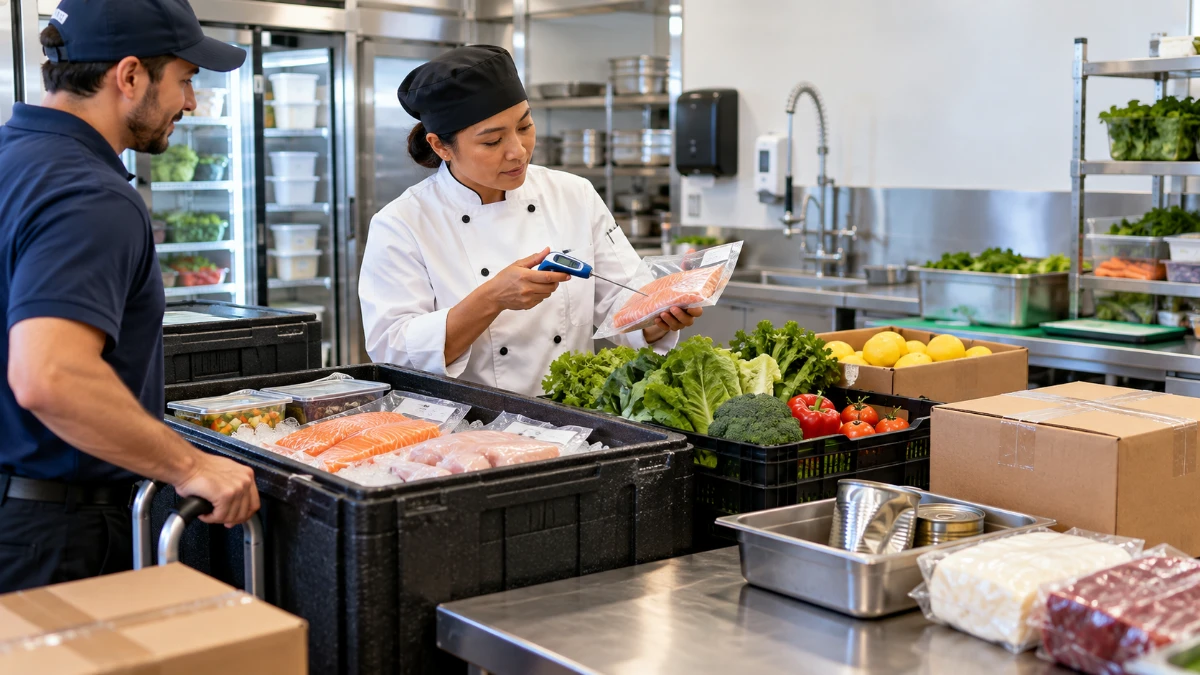
Safe receiving is worth 13 of the 80 scored ServSafe Manager questions, and the rule behind all of them is short: inspect the delivery before you sign for it, and reject anything that fails on temperature, packaging, source or condition. A signed invoice means you own the product, so every check happens on the dock, with a thermometer in your hand.
The receiving questions on the exam are scenarios, so it helps to rehearse them one content area at a time. The Safe Receipt, Storage, Transportation and Disposal domain test does that for this area alone.
What does receiving a delivery safely involve?
Receiving is the moment a supplier’s product becomes your responsibility. Everything downstream, from storage to cooking to service, depends on what you let through the back door, and nothing later in the kitchen can repair a delivery that arrived unsafe. A thawed case, a broken seal, a sour smell or a missing shellstock tag can each turn a routine drop into a hazard.
A proper check covers five things at once: temperature, packaging, product condition, signs of pests or contamination, and the paperwork that traces the product to an approved source. The exam treats receiving as a decision under pressure, so the order you work in matters as much as the list.
The ServSafe Manager exam is 90 multiple-choice questions in two hours, but only 80 of them count. The other 10 are unscored pilot items the National Restaurant Association uses for research, and nothing on screen tells you which is which. You pass at 56 of the 80 scored questions — 70%, not the 75% most prep sites publish.
Our full-length ServSafe Manager practice tests copy that structure exactly: 90 questions, 10 unmarked pilot items, a two-hour countdown that submits at zero, and a result worked out of 80 against the same pass line. The seven content areas carry the real exam’s weights rather than an even split — Preparation and Cooking 15, Receipt and Storage 13, Hygiene and Health 12, Cleanliness and Sanitation 12, Facilities and Equipment 12, Management 8, Service and Display 8.
What do you check, and in what order?
Work from the outside in, and finish before you sign. The sequence below puts the fastest, most disqualifying checks first, so a bad delivery fails early, before the whole truck is unloaded.
| Step | What you look at | What stops the delivery |
|---|---|---|
| 1. Truck and driver | Cargo area cleanliness, odor, separation of raw food from ready-to-eat food, chemicals loaded beside food, refrigeration running | A dirty, warm or foul-smelling cargo area; chemicals next to food |
| 2. Supplier and paperwork | Invoice against the order, approved supplier, lot codes, shellstock tags on live shellfish | Unfamiliar supplier, missing records, substituted product with no explanation |
| 3. Temperature | A calibrated probe in the product, cold and hot items first, frozen items by feel and by signs of thawing | A reading outside your code’s limit for that product; frozen food that is soft |
| 4. Packaging | Seals, tears, leaks, swelling, rust, water damage, juices from raw product | Anything broken, swollen or leaking |
| 5. Product condition | Smell, color, texture, mold, slime; signs of pests such as droppings, gnaw marks or insects | Off odor, slime, mold or any evidence of pests |
| 6. Labels and dates | Product labels, date codes, shell egg condition | Missing or inconsistent labeling; dirty, cracked or broken shell eggs |
Temperature gets its own step because it is the fastest way to spot trouble, and packaging gets its own because it catches what a thermometer cannot. Use a probe on the product wherever you can. For reduced-oxygen packaging, slide the stem between packages rather than piercing one. An infrared thermometer is useful for a quick scan of the load, and a probe is what you rely on for the decision.
Which temperature limits apply at the dock?
The limits for cold, hot and frozen deliveries come from the food code your jurisdiction has adopted and from your own written procedure, and editions of the code differ in details. This post does not restate numbers that you should be reading from your local code or from ServSafe’s own materials. What it can fix in your head is the logic each limit follows.
| Delivery type | What you measure | What a failure looks like |
|---|---|---|
| Cold food that needs temperature control | Internal product temperature against your code’s cold limit | A reading above the limit; a warm cargo area; condensation inside the case |
| Hot food | Internal product temperature against your code’s hot limit | A reading below the limit; food that arrives lukewarm after a long delay |
| Frozen food | Firmness, ice crystals, water stains, refrozen liquid in the case | Soft product, large ice crystals or liquid that has pooled and refrozen |
| Live shellfish | Tags, shell condition, cleanliness of the container | Missing tags, many open shells that do not close when tapped, foul odor |
| Ready-to-eat items such as salads and deli meat | Internal temperature plus seal and appearance | Warm product, broken seal, swelling, slime, off odor |
Frozen and ready-to-eat food each carry a trap. A thawed and refrozen product can look fine from the outside, and the ice crystals and stained cartons are what give it away. Ready-to-eat food deserves extra suspicion because nothing later in your kitchen will cook it, so a delivery that arrives warm leaves no kill step to rescue it.
What are the red flags that should stop the check?
Some signs do not mean automatic rejection, but they mean you slow down and inspect harder before anything is accepted.
| Red flag | What it points to | Next move |
|---|---|---|
| Truck is warm, dirty or smells bad | A failed refrigeration unit or poor sanitation in transport | Probe the first items before unloading anything |
| Wet, greasy or crushed boxes | Melted ice or leakage from raw protein | Open the case and inspect what sits beneath |
| Frozen items feel soft | Thawing during transit | Check for crystals, stains and refrozen liquid; reject if present |
| Raw and ready-to-eat food loaded together | Risk of cross-contamination in transit | Reject the exposed ready-to-eat items |
| Chemicals loaded beside food | Possible chemical contamination | Reject anything the chemicals could have touched |
| Driver cannot produce records | Weak supplier controls | Hold the delivery until paperwork is verified |
| Labeling missing or inconsistent | Traceability gap | Reject if the product cannot be traced |
When do you reject, partially reject, or accept with a note?
Reject when there is a clear safety, quality or traceability failure. The decision protects guests first, and it protects the business second, because accepting suspicious food to avoid an argument buys a larger loss later in spoilage, illness complaints and citations.
| Outcome | When it applies | What to record |
|---|---|---|
| Full rejection | The failure affects the whole load: failed refrigeration, pest evidence, shared contamination | Supplier, reason, readings, who decided, and the invoice noted |
| Partial rejection | The bad product can be cleanly separated from the rest | The rejected items, the reason, and the accepted remainder |
| Accept with a note | A minor issue your written policy allows, with no safety failure | The condition observed and the policy that permits acceptance |
Be specific when you reject. A note that says a case of chicken probed above the cold limit, or that the seal on a salad case was broken, holds up in a dispute. A note that says the food looked bad does not.
What should the receiving record say?
Memory is weak and disputes happen, so the record carries the argument for you. For anything rejected or questioned, write down the date and time, the supplier, the product and quantity, the problem you saw, the reading if it involved temperature, the lot code or invoice number, and the name of the person who made the decision. Note whether the product was fully rejected, partially rejected or accepted with a note under company policy.
That record does three jobs. It is your evidence if the supplier contests the rejection, it supports traceability if a recall or illness investigation reaches your back door, and it shows patterns, such as one vendor repeatedly sending warm dairy. Shellstock tags are the special case: keep them for the period your local code requires after the last shellfish from the container is used, because they tie the product to its harvest source. Verifying the source in the first place is the subject of how source control is tested on the exam.
How do receiving decisions play out on a real dock?
Three short cases show how the exam frames them. In each, the right answer comes from applying the standard to one product at a time.
A truck delivers a case of yogurt, frozen burger patties and bagged lettuce. The yogurt probes above the cold limit, so it is rejected. The patties arrive in a box with water stains, which points to thawing, so they are rejected as well. The lettuce is cold, sealed and intact, so it is accepted. One truck, two rejections, one acceptance, and three lines on the receiving log.
A case of chicken arrives dry, intact and within limit, so it is accepted. A second case arrives wet, with pink liquid pooled in the bottom and a reading above the limit. The driver says it was just loaded. Both the reading and the leak point to poor temperature control, and a claim about timing does not change either measurement, so the case is rejected.
A delivery of oysters arrives with closed shells and complete shellstock tags. That is the good outcome. If many shells were open and stayed open when tapped, or the tags were missing, the shipment would go back. The shells describe condition and the tags describe source, and you need both to accept.
How do you practice receiving decisions before the exam?
Receiving questions reward people who have made the call a few times, even on paper. Read how the exam frames these decisions in the Manager receiving and storage question breakdown, then look at what happens to accepted product next in this FIFO storage guide. Pest evidence found at the dock connects to the facility and pest control questions, which is worth reading as a pair.
When you want to test yourself under real conditions, the full-length 90-question Manager practice test runs the exam’s own structure with a two-hour clock, and the ServSafe Manager practice test hub holds the free sets for drilling single areas first.
Frequently asked questions about receiving food deliveries
Who should sign for a delivery?
Only someone trained to inspect it. The signature tells the supplier the order arrived as invoiced and in acceptable condition, so the person holding the pen needs to know the rejection criteria. A dishwasher who signs to be helpful has just accepted whatever is on the pallet, including anything that should have gone back on the truck.
Should the truck get inspected before the product comes off?
Yes, take a quick look first. A dirty cargo area, a strong odor, chemicals stacked beside food or a refrigeration unit that is clearly not running all point to a transport failure before you have touched a case. If the truck itself looks wrong, probe the first few items before anything is unloaded.
Do I check every case or a sample?
Check every delivery, and check every high-risk product on it. Refrigerated, frozen and ready-to-eat items get probed individually because one warm case does not tell you about the next one. Shelf-stable cases get a visual check of packaging and labels. Your written procedure should say how many units of each type you inspect.
What do I do when the driver is in a hurry?
Finish the inspection anyway and say so calmly. The driver’s schedule does not move the point of acceptance, and a rushed signature is how a bad delivery becomes your problem. If the truck cannot wait, take the cold and frozen items first, set them aside to check, and sign only after those pass.
Can a delivery be left when no one is on site?
Leaving food unattended at a door removes your chance to inspect it, so your written procedure should forbid it for temperature-controlled products. Where a supplier insists on drop-offs, a manager has to inspect the product the moment staff arrive and reject it then if it fails. Put that arrangement in writing before the first drop.
Is a swollen can an automatic rejection?
Treat it as one. A can that bulges at the ends or sides suggests something inside produced gas, and no later step in your kitchen will make that product safe. Rejecting a swollen can costs a few dollars and a phone call; serving it can cost a lot more. Dents are a judgment call, bulges are not.
How do I get credit for rejected product?
Ask the driver to note the rejection on the invoice, then keep your copy and your receiving record. Credit is a commercial arrangement between you and the supplier, and it depends on evidence: the product name, the problem, your reading if it was temperature, and the name of the person who decided. A vague note invites an argument.
Should I photograph a problem delivery?
A photo helps, and it never replaces the written record. Take it before the product leaves your hands, showing the label or lot code beside the defect, and file it with the invoice. If the supplier disputes the rejection, a dated picture of a leaking case settles more arguments than your memory of it will.
Where does rejected food go while the driver is still there?
Back on the truck, or in a clearly marked rejected area that is separate from your stock and away from anything ready to eat. Never leave it in the walk-in to be sorted later. Rejected product that mixes with accepted product loses its identity, and then nobody can say which cases were actually checked.
Can an infrared thermometer clear a delivery?
It can raise a warning, but a surface reading cannot clear the product. An infrared thermometer reads the outside of a package, which responds to room air faster than the food inside. If the reading looks off, confirm with a clean, calibrated probe. If it looks fine on a high-risk item, a probe is still the safer check.
Where does the probe go when the food is in packaging?
Probe the product itself wherever you can do it without breaking the package. For vacuum-packed or reduced-oxygen items, slide the stem between two packages instead of piercing one. For liquids, take the reading from the container’s contents. Clean and sanitize the probe between products so the thermometer does not carry contamination from one case to the next.
Do dry goods need a receiving check?
Yes, though the check is different. Dry goods are not temperature-controlled, so you look at packaging, dates, pests and moisture instead. Wet or crushed boxes, chewed corners, droppings and insect activity all mean the product, and possibly the whole shipment, stays out of dry storage. One infested case can follow you into the stockroom.
What should I do when produce arrives wet?
Look at why it is wet before you decide. Condensation on cold produce is routine. Dripping boxes, slime, mold, or liquid that looks like it leaked from raw protein beside it are rejection signals. Check what else rode in the same part of the truck, because wet produce often means a raw product leaked onto it.
What if the invoice does not match the product?
Do not sign until the difference is resolved or written on the invoice. A short shipment is a billing issue, but a substitution is a food safety issue, because the replacement may come from a different source or contain an allergen your menu does not account for. Record the change and confirm the substitute against your approved supplier list.
Should the walk-in be cleared before the truck arrives?
Yes, make room first. A walk-in jammed with old stock forces staff to leave cold product on the dock while they shuffle shelves, and that wait is where temperature abuse happens after acceptance. Clear space, stage carts and have thermometers sanitized and in hand before the truck backs up.
Why check the delivery before signing the invoice?
Because the signature is your acceptance. Once the invoice is signed, the supplier can reasonably argue that the product arrived in good order, and your leverage to reject or claim credit shrinks. Inspect first, sign second. The same sequence is what exam questions expect when they ask what a manager should do on the dock.
Can I accept a delivery if only one item is bad?
Yes, if the bad item can be cleanly separated from the rest. Reject that product, note it on the invoice and accept what passed. If the problem is shared by the whole load, such as a failed refrigeration unit or a pest-infested truck, reject the full shipment, because you cannot trust anything that rode in the same conditions.
Why does damaged packaging matter if the food is still cold?
A safe reading answers one hazard, and broken packaging raises others. Tears, leaks and broken seals let in dirt, chemicals, pests and juices from other products. Temperature is the fastest check, which makes it tempting to stop there, but a passing temperature on a leaking case still means contaminated food.
What should the receiving log show at the end of a shift?
Every delivery that arrived, with the supplier, the time, the readings on temperature-controlled items, and every rejection or partial rejection with its reason. Read it at the end of the shift for patterns. A supplier who shows up in the rejection column again and again is giving you a vendor-review decision.
What if my staff and the driver disagree about a rejection?
The person accepting the delivery makes the call, and the manager backs it. Point to the measurement or the defect and write both on the invoice. A probe reading and a photographed leak are hard to argue with. If it escalates, hold the product apart and call the supplier’s office while the evidence is fresh.
Reviewed 2 October 2026 against ServSafe Manager exam facts (90 questions, 80 scored, 56 to pass, 13 of 80 in Safe Receipt, Storage, Transportation and Disposal of Food). Temperature limits are deliberately not stated here; read them from your local food code and your written procedure.